

News Categories

Buying an industrial steam kettle with agitator usually starts with one question: what size should it be? Many buyers pick the largest vessel in the catalog and later discover that they can never fill it completely, or they pick a smaller model and find that one batch of viscous sauce pushes right up against the rim. The missing piece is usually not the rated capacity printed on the nameplate. It is the working batch — the amount of product a steam kettle with agitator can safely process in one cycle.
Rated capacity describes the geometric volume of the vessel. Working batch describes what can actually be cooked in it, which is always lower because heat, steam, agitation, and foam all need space. This article explains the difference, shows how to size a steam kettle with agitator from your target batch weight, and covers the practical factors that affect usable volume.
The working batch of a steam kettle with agitator is usually 75–80% of its rated capacity; the remaining headspace allows for boiling, foam, and agitation surge.
To size a kettle, divide the target batch weight by the working factor (for example 0.8) and round up to a standard rated capacity.
High-viscosity, starch-based, or strongly foaming products need more headspace, often 70–75% of rated capacity.
Standard industrial kettles range from 100 L to 1,200 L or more; the right size depends on batch weight, cycle time, and line capacity, not on the biggest number in the catalog.
Agitator type, scraper coverage, discharge method, and plant layout affect usable capacity as much as vessel volume does.

Rated capacity is the total internal volume of the vessel, measured when the kettle is geometrically full. A 300 L steam-jacketed kettle, for example, holds 300 litres of water up to the brim of the bowl. This figure is simple and standardized, which is why it appears on datasheets and quotations. But it is a container specification, not a production specification.
Working batch is the amount of product loaded into the kettle for one cooking cycle. It is always smaller than rated capacity for three physical reasons. First, most products expand when heated; a sauce that fills 80% of the bowl at ambient temperature may rise noticeably during boiling. Second, agitation pushes the product into a moving wave, and the scraper arms need clearance to sweep the surface without slinging material out. Third, many processes produce foam or steam bubbles that need headspace above the liquid. Industry practice therefore sizes the working batch at roughly 75–80% of rated capacity, a commonly used rule of thumb for jacketed cooking vessels.
Loading a steam kettle with agitator to 100% of rated capacity invites overflow, scorching on the rim, and product loss during every cycle. A batch that spills over a heating surface also creates a cleaning problem in a hygienic plant. Keeping a defined headspace turns these events from a daily risk into a non-issue.
A steam-jacketed kettle transfers heat through the vessel wall. When a steam kettle with agitator is loaded to its working batch, the product covers the maximum jacket area while headroom remains for expansion. If the jacket is not fully covered by product, part of the steam energy heats empty wall instead of the batch, slowing cook times and wasting steam. This is why two kettles with the same rated capacity can produce at different rates when one is correctly loaded and the other is not.
The agitator and its PTFE scrapers are sized for the vessel geometry. At the correct working batch, the scraper blades sweep the curved bottom and wall continuously, preventing burn-on in high-viscosity products. Overfilled, the material climbs above the effective scraper zone; underfilled, the scrapers work against a shallow layer and heat transfer drops. Working volume keeps the scraper system where it was designed to operate.
A practical starting point for sizing a steam kettle with agitator on water-based and moderately viscous products is:
Rated capacity needed ≈ target batch weight (kg) ÷ 0.8
For thick, starchy, or foaming products, use a more conservative factor: rated capacity ≈ target batch weight ÷ 0.7–0.75
Water and most food slurries weigh close to 1 kg per litre, so kilograms and litres can be treated as equivalent for the initial calculation. The examples below use the 0.8 working factor.
| Target Working Batch | Calculation | Recommended Rated Capacity |
|---|---|---|
| 160 kg of soup or broth | 160 ÷ 0.8 = 200 L | 200 L steam kettle with agitator |
| 320 kg of sauce | 320 ÷ 0.8 = 400 L | 400 L steam-jacketed kettle |
| 480 kg of jam or filling | 480 ÷ 0.8 = 600 L | 600 L heavy-duty steam kettle |
| 800 kg of thick paste | 800 ÷ 0.75 = ~1,067 L | 1,200 L heavy-duty kettle |
The fourth row shows why viscous products deserve a lower factor: a 1,200 L vessel running at roughly 75% working volume handles an 800 kg paste batch, while a formula using 0.8 would under-size the vessel and force daily overloading.
Industrial steam kettles with agitators are commonly offered in standard steps from 100 L to 500 L for general production, and from 600 L to 1,200 L or more for heavy-duty lines. The table maps typical working batches to these sizes using the 0.8 factor.
| Rated Capacity | Typical Working Batch (≈80%) | Typical Applications |
|---|---|---|
| 100 L | ~80 kg | R&D batches, small sauce lines, pilot recipes |
| 200 L | ~160 kg | Restaurant chains, bakery fillings, curry base |
| 300 L | ~240 kg | Central kitchens, soup and broth production |
| 400 L | ~320 kg | Medium sauce plants, jam and puree lines |
| 500 L | ~400 kg | Multi-line condiment production |
| 600 L | ~480 kg | Heavy-duty paste cooking, large central kitchens |
| 800 L | ~640 kg | Continuous-feed sauce and filling lines |
| 1,000 L | ~800 kg | Industrial caramel, puree, and broth reduction |
| 1,200 L | ~960 kg | Large-scale paste, jam, and stew production |
Free-flowing liquids (soups, thin syrups): 80% working factor is usually safe.
Starch gelatinization (custards, roux, bean pastes): expect strong swelling; use 70–75%.
Foaming products (milk-based sauces, some dressings): keep at least 25–30% headspace.
High-viscosity pastes: the scraper system needs full bowl contact; stay within 70–75% to avoid strain on the drive.
In practice, a steam kettle with agitator running starch-based fillings should be treated more conservatively than one running thin broth, even when both vessels have the same rated capacity.
Total output is batch weight divided by cycle time. A plant that needs 2,000 kg of sauce per shift can run two 500 L kettles at two batches per hour each, or one 1,000 L kettle at one batch per hour. The right choice depends on space, labour, steam supply, and whether the line needs continuous flow or flexible scheduling. When planning a steam kettle with agitator, buyers should size for the largest routine batch, not the occasional peak.
A larger steam-jacketed kettle needs a matching steam supply. Jacket working pressure in this product family is 0.2–0.4 MPa with a maximum test pressure of 0.6 MPa, and operating temperature ranges from ambient to 120°C. If the plant boiler cannot deliver enough steam, a larger kettle will simply heat slower than specified, which defeats the purpose of the extra volume. Before choosing rated capacity, confirm that the boiler can feed the largest steam kettle with agitator on the line.
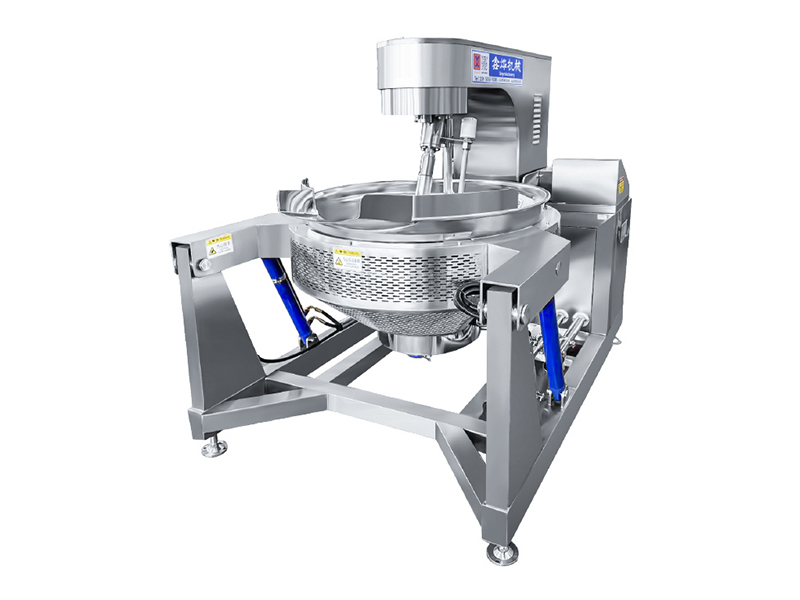
Hydraulic tilting up to 90° discharges product into 200 L buggies or hoppers, so the space in front of the kettle must be clear. Door widths, ceiling height, and the path to the discharge area limit the physically usable size as much as the recipe does. Measuring the installation bay before choosing a capacity avoids a delivery-day surprise. A steam kettle with agitator that fits the line but not the building is of little value, so layout checks should happen before the purchase order.
PLC-controlled steam kettles repeat batch time, agitation speed, and steam valve opening precisely. When a plant standardizes on a working batch, the PLC program locks that loading level, which protects the vessel from operator error and keeps the 80% rule enforced automatically. A PLC-controlled steam kettle with agitator also makes it easy to scale a validated recipe from one rated capacity to another during line expansion.
To see how these criteria apply in practice, buyers can compare representative steam kettle models from the same manufacturer:
Steam-jacketed kettle with planetary PTFE scrapers, 100–1,200 L capacities, hydraulic tilting, and PLC recipe control for sauces, fillings, and stews.
View Product
Planetary cooking mixer heated by a steam jacket, with self-rotating scrapers for high-viscosity bakery pastes and fillings.
View Product
Multi-claw steam-jacketed cooking mixer for large batches of paste, jam, and concentrated products in central kitchens and food plants.
View ProductXINYE manufactures industrial steam kettles with agitators from 100 L to 1,200 L or more, with CE / ASME-compliant pressure-vessel construction, sanitary SUS304 / SUS316L stainless steel, and PLC recipe automation. Send an inquiry with your target batch weight, product type, and cycle time for a capacity recommendation.
Get a QuoteView Steam Kettles →Choosing the right size for a steam kettle with agitator comes down to working batch, not rated capacity. Plan for 75–80% usable volume, recalculate for viscous or foaming products, and match the kettle size to the batch weight, cycle time, and steam supply of the plant. A correctly sized steam-jacketed kettle heats faster, cleans easier, and protects both the product and the equipment.
For buyers looking for a dependable steam kettle with agitator manufacturer, XINYE offers engineer-led manufacturing, certified pressure-vessel build, and customized capacity from 100 L to 1,200 L and beyond.
Using the 80% rule of thumb, a 200 L steam kettle with agitator handles roughly 160 kg per batch. Thicker or foaming products should be limited to 140–150 kg to keep safe headspace.
At least 20–25% of the rated capacity. For a steam kettle with agitator running free-flowing liquids, 20% is usually enough; starchy, swelling, or foaming products need 25–30% to prevent overflow during boiling and agitation.
No. Filling a kettle to its geometric volume leaves no room for expansion, foam, or agitation surge, which causes overflow, product loss, and uneven heating. Working batch should stay at 75–80% of rated capacity.
Divide the target batch weight by 0.7–0.75 instead of 0.8. For example, 800 kg of thick paste needs a kettle rated near 1,067–1,143 L, so a 1,200 L model is the practical choice.
Divide 300 kg by 0.8, which gives 375 L. A steam kettle with agitator rated at 400 L is the standard size that covers this working batch with margin.
Yes. The agitator and PTFE scrapers need clearance to sweep the full bowl surface. Overloading pushes product above the effective scraper zone and can strain the drive, so usable volume is defined by the agitator geometry as well as the vessel.
The 75–80% working-volume rule for jacketed cooking vessels is a widely used industry practice for sizing; actual figures depend on product rheology and process conditions.
Vessel capacities (100 L – 1,200 L+), jacket working pressure (0.2–0.4 MPa, max test 0.6 MPa), operating temperature (ambient to 120°C), PTFE scraper heat resistance (260°C), drive power, agitation speed, and discharge options are taken from the XINYE product page for the Industrial Steam Kettle with Agitator: https://www.xinyefoodmachine.com/Industrial-Steam-Kettle-with-Agitator-for-Commercial-Food-Processing.html.
ASME — publisher of the Boiler and Pressure Vessel Code referenced for certified pressure-vessel construction: https://www.asme.org/.
FDA — U.S. Food and Drug Administration guidance on food contact materials and equipment hygiene: https://www.fda.gov/food.
NSF — public health standards and certification organization covering food equipment sanitation: https://www.nsf.org/.
Company statements (engineer-led manufacturing, factory-direct pricing, lifecycle performance) are stated according to XINYE and were not independently verified by this article.
Product images are from the XINYE website and are used for illustration of the referenced product lines.

 Phone:0086-15908033216
 E-mail: olivia.xinye@gmail.com
 Whatsapp/WeChat: +86 15169588915
 ADD: No.78, Jianqiao Road, Shunwang Sub-district, Zhucheng City, Weifang City, Shandong Province
Customer Message
Designed by Zhonghuan InternetCopyRight © 2026 ZHUCHENG XINYE MACHINERY CO., LTD. All rights reserved All tags Sitemap