



News Categories

Running a busy kitchen is a constant balancing act — peak-hour rushes, staff shortages, food quality standards, and rising energy bills all compete for attention at once. For central kitchens, large restaurants, and food production facilities, a key part of the answer lies in adopting a reliable commercial stir fry machine. But not every unit on the market delivers the same results. Knowing which features actually matter — and which are just marketing noise — can save a kitchen operator significant time, money, and frustration.
This guide examines the top 6 features that kitchen managers and procurement teams should evaluate when selecting automated cooking equipment for high-volume stir-fry and cooking operations.
Heating technology — gas vs. induction — is the single most important decision and depends on a kitchen's energy infrastructure and dish requirements.
A 3D agitation system is essential for achieving even cooking without crushing delicate ingredients like rice grains or soft proteins.
True automation means one operator can manage multiple machines simultaneously, dramatically reducing labour dependency.
A seamlessly stamped stainless-steel cooking surface prevents burn-on and speeds up cleaning between batches.
Precise temperature control and safety features protect both product quality and kitchen staff.
Batch output and overall dimensions must be matched to the kitchen's actual throughput needs before purchasing.
Pressure on commercial kitchens has never been greater. According to the National Restaurant Association's 2024 State of the Restaurant Industry report, 47% of operators anticipate that technology and automation will become more common as a direct response to ongoing labour challenges. Meanwhile, 92% of operators reported rising labour costs in the previous 12 months — a figure that makes any investment in automated cooking equipment highly attractive when the numbers are run over a multi-year horizon.
For stir-frying specifically, the challenge has always been consistency. Skilled wok chefs are difficult to hire and even harder to retain. When one person leaves, an entire menu section can suffer. The right equipment solves this by locking in consistent temperature, timing, and stirring motion — delivering the same result batch after batch, regardless of who is on shift that day.
The six features below are what separate a genuinely productive kitchen investment from a unit that sounds impressive on paper.
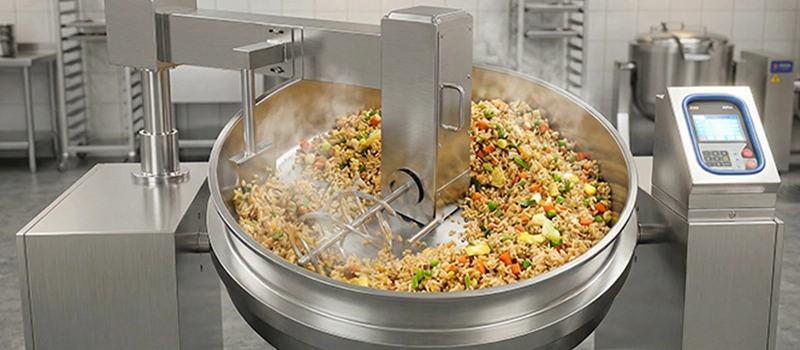
The heating system is the heart of any commercial stir fry machine, and the choice between gas and induction fundamentally shapes both the cooking result and a kitchen's running costs for years to come.
Gas-fired units deliver intense, open-flame heat that rapidly evaporates surface moisture from ingredients. This is the mechanism behind "Wok Hei" — the signature smoky, charred aroma that defines authentic stir-fry and fried rice dishes. For restaurants where that flavour profile is non-negotiable, a gas setup remains the reference standard.
Induction units use electromagnetic energy to heat the cooking surface directly, without an open flame. Research consistently shows that commercial induction cooking equipment operates at 85–90% thermal efficiency, compared to just 40–55% for gas. In practical kitchen terms, this translates to a cooler working environment, lower ventilation demands, and significant savings on energy bills — often in the range of 30–40% compared to gas equivalents. Induction-based stir fry equipment is also the preferred choice in facilities with strict indoor air quality requirements or smoke-free kitchen regulations.
| Heating Type | Thermal Efficiency | Best For | Key Advantage |
|---|---|---|---|
| Gas Heating | ~40–55% | Fried rice, stir-fried noodles, high-aroma dishes | Authentic open-flame Wok Hei flavour |
| Induction Heating | ~85–90% | Central kitchen meals, pilaf, mass catering | Up to 40% energy saving, smoke-free operation |
The agitation mechanism — the arm or scraper system that moves food through the cooking pan — is where many lower-cost stir fry units fall short. In a traditional wok, a skilled chef uses a specific tossing and folding motion to ensure every grain or piece of ingredient contacts the heat source evenly without being crushed. Replicating this at industrial scale requires careful engineering.
Standard high-speed rotating agitators apply direct mechanical force to ingredients. For delicate items like cooked rice, this results in broken, mushy grains rather than the distinct, separate texture that defines quality fried rice. The solution lies in a 3-scraper loosening system, where multiple scrapers work in coordinated motion to gently lift, separate, and redistribute ingredients through the pan without compressing them.
The best units combine this scraper action with a wide, flat-bottomed cooking surface — typically around 1,100 mm in diameter and 250 mm deep — to maximise the area available for moisture evaporation. This combination achieves the two key goals of professional stir-frying: distinct grain separation and rapid surface moisture release.
For sauce and paste applications, a tilted planetary agitation system — where the mixing arm revolves around the pan while simultaneously rotating on its own axis — ensures zero dead spots along the edges, delivering uniform mixing across the entire batch. This non-integer transmission approach guarantees that every part of the cooking vessel is reached on every cycle.
The degree of automation built into a unit determines how many staff are needed to run it and how consistent the output will be across different shifts and operators.
Entry-level machines may automate the stirring motion but still require an operator to manually monitor temperature, manage timing, and supervise each batch. More capable systems allow a single technician to set a programme — including cooking time, agitation speed, and temperature curve — and then step away to load or monitor additional units simultaneously.
The most advanced options combine automatic ingredient introduction, automated discharge (the machine tilts or opens to empty cooked food), and programmable recipe storage. This means a kitchen can maintain consistent dish quality regardless of which staff member is on duty — a critical advantage in an industry where skilled back-of-house labour turnover remains persistently high.
| Automation Level | Operator Requirement | Consistency | Ideal Application |
|---|---|---|---|
| Semi-Automatic | 1 operator per machine | Moderate | Small restaurants, limited menus |
| Programmable Auto | 1 operator per 2–3 machines | High | Multi-dish central kitchens |
| Fully Automated Line | Supervisory role only | Very High | Industrial food production facilities |
The materials and construction method used directly affect two things: how long the unit lasts and how easy it is to keep clean — which in turn affects the safety of every batch of food it produces.
The cooking pan or kettle body should be formed using a one-step hydraulic stamping process, rather than being hand-welded together from sections of metal. Stamped bodies have a smooth, perfectly round interior surface with no seams, gaps, or uneven welds. This matters for two reasons: scrapers can maintain full, seamless contact with the cooking surface throughout each rotation (preventing hot spots and burn-on), and there are no crevices where food residue, grease, or bacteria can accumulate between cleaning sessions.
Hand-welded construction leaves micro-gaps at weld points. These areas are notoriously difficult to clean properly and represent a genuine food safety risk in any professional kitchen. When evaluating options, buyers should always request detailed information about the pan construction method and ask to inspect the interior finish.
All food-contact surfaces should be made from food-grade stainless steel. Professional kitchen equipment certifications — such as those evaluated against NSF/ANSI standards, which cover material safety, cleanability, and construction quality — provide a useful independent reference point when assessing a machine's suitability for professional use.
Precise temperature management separates equipment that consistently delivers high-quality results from equipment that produces unpredictable outcomes. In stir-fry cooking, the most common failure mode is a sudden temperature drop when cold or room-temperature ingredients are added to a hot pan. If the heating system cannot recover quickly, the bottom layer of food continues to cook while top layers remain undercooked — resulting in burn-on at the base and raw patches throughout the batch.
Quality units address this through dual-inverter heating control, which allows the machine to respond dynamically to temperature changes rather than operating at a fixed power level. When a drop is detected — as happens when fresh ingredients are loaded — the system immediately increases heating output to compensate, maintaining a consistent cooking environment throughout the cycle.
On the safety side, busy kitchens need equipment that protects staff. Important safety features to look for include:
Automatic overheating cutoff — shuts the unit down if temperatures exceed safe operating limits, protecting both equipment and nearby staff.
Enclosed heating elements — on induction models, the absence of open flames removes one of the most significant fire hazard sources in a busy kitchen.
Automated tilting discharge — motorised tilting to empty cooked food eliminates the need for staff to manually lift or pour from a heavy, hot cooking vessel.
Stable base construction — essential to prevent vibration-related movement during continuous high-output cycles.
Even the most technically advanced commercial stir fry machine creates operational problems if it is sized incorrectly for the kitchen that operates it. A unit with too small a batch capacity creates bottlenecks during peak service; one that is physically too large may not fit within the existing layout or may require electrical or gas infrastructure upgrades that significantly increase total cost of ownership.
Industrial-grade stir fry units are typically available with cooking vessels ranging from 100 litres up to 500 litres, with per-batch outputs in the range of 20–25 kg for fried rice and similar dishes. For sauces, pastes, and higher-viscosity products, planetary cooking mixer configurations handle volumes from 100L to 500L with maximum load capacities of 60 kg to 280 kg depending on the model.
| Machine Type | Vessel Volume | Batch Output | Heating Power | Footprint (approx.) |
|---|---|---|---|---|
| Induction Fried Rice Machine | 200L (1200mm pot) | ~22 kg/batch | 34 kW | 1400×2100×1400 mm |
| Gas Fried Rice Machine | 200L (1200mm pot) | ~20 kg/batch | 3 kW (motor) | 1500×2100×1500 mm |
| Gas Planetary Cooking Mixer (200L) | 200L | Up to 120 kg load | 3 kW (motor) + gas | 1950×1500×1650 mm |
| Induction Planetary Cooking Mixer (500L) | 500L | Up to 280 kg load | 2.2 kW + 50 kW heating | 1900×2200×1800 mm |
When calculating the required capacity, kitchen operators should factor in not only current peak demand but also projected growth over a 3–5 year horizon, since well-built industrial cooking equipment typically has a long operational lifespan. It is generally more cost-effective to select a unit with slightly more capacity than currently needed than to invest in additional machines at full price later.
| Feature | What to Look For | Red Flag to Avoid |
|---|---|---|
| Heating Technology | Gas for Wok Hei; Induction for energy efficiency | No choice between heating types offered |
| Agitation System | 3-scraper or planetary system with zero dead spots | Single high-speed blade that crushes ingredients |
| Automation Level | Programmable cycles; one operator per multiple machines | Constant manual monitoring required |
| Build Quality | One-step stamped stainless-steel cooking surface | Hand-welded seams inside the cooking vessel |
| Temperature Control | Dynamic dual-inverter with overheating cutoff | Fixed single-power heating with no auto-adjustment |
| Capacity & Footprint | Matched to actual throughput; 100L–500L range available | One-size-only option with no scalable configuration |
In a high-volume operation running multiple batches per shift, the time spent cleaning the cooking vessel between cycles directly impacts overall throughput. Units with complex internal geometries, manual discharge processes, or recessed areas where food collects can add 15–20 minutes of cleaning time per cycle — hours of lost productivity across a full service day.
The most practical designs address this through a combination of smooth stamped interiors (which give food fewer surfaces to adhere to), motorised tilting discharge (which empties the vessel quickly and completely), and scraper systems that continuously move food away from the sides and bottom throughout cooking, leaving far less residue to deal with afterward.
XINYE engineers industrial stir fry machines and cooking automation solutions for central kitchens, restaurant groups, and food production facilities worldwide. Their team provides customised equipment matching based on each kitchen's specific dish requirements, output targets, and energy infrastructure — with a detailed technical proposal and factory-direct quote within 24 hours.
Send an Inquiry to XINYE — Get a Free Custom QuoteNo obligation. Response within 24 hours. Factory-direct pricing.
Selecting the right commercial stir fry machine for a busy kitchen comes down to six core features: the heating technology that matches both dish style and energy costs; an agitation system that moves food gently and evenly without damaging it; a level of automation that reduces staffing dependency; a build quality based on seamless stamped stainless steel; dynamic temperature control with meaningful safety protections; and a batch capacity sized correctly for current and future throughput.
Operators who evaluate equipment against these six criteria — rather than purchasing on price alone — consistently report better food quality, lower staffing costs, faster cleaning turnarounds, and machines that remain reliable across years of intensive daily use. For kitchens serious about scaling up production without scaling up headcount, purpose-built stir fry automation from a specialist manufacturer is one of the most effective capital investments available in the foodservice industry today.
For buyers seeking a proven commercial stir fry machine manufacturer with deep industrial experience, XINYE offers a comprehensive range of stir fry and planetary cooking solutions tailored to central kitchens, restaurants, and food production operations of all sizes.
It is an industrial cooking unit designed to replicate high-heat wok cooking at scale. A motorised agitator, a heated cooking pan, and programmable controls work together to produce large batches consistently without continuous manual supervision — allowing one person to manage multiple units at the same time.
Industrial-grade models typically produce 20–25 kg per batch for fried rice and similar dishes. For sauces and pastes processed in planetary cooking mixer configurations, maximum load capacities range from 60 kg (100L vessel) to 280 kg (500L vessel) depending on product viscosity and machine specification.
Neither is universally superior — it depends on the kitchen's priorities. Gas delivers authentic Wok Hei flavour and suits restaurants where that aroma defines the dish. Induction operates at 85–90% thermal efficiency, creates a cooler, smoke-free environment, and typically reduces energy costs by 30–40% versus gas. Many central kitchens use induction for volume production and retain gas stations for specialist dishes requiring open-flame character.
Modern units are engineered so that a single operator can oversee several machines simultaneously. Once ingredients are loaded and a programme is set, the unit manages agitation, temperature, and timing automatically. Staff are freed to handle ingredient preparation, portion control, and quality checks rather than standing over each machine throughout the cook cycle.
Units with a seamlessly stamped cooking surface and automatic tilting discharge are comparatively fast to clean — the smooth interior reduces food adhesion, and motorised tilting empties the vessel completely without manual lifting. Machines with hand-welded interiors or complex geometries take significantly longer and carry greater hygiene risk.
Stir fry machines handle fried rice, stir-fried noodles, canteen dishes, and pilaf. Planetary cooking mixer variants additionally process chili sauces, curry pastes, hotpot bases, bean pastes, caramel, and other high-viscosity cooking products — making the same platform useful across both meal production and sauce manufacturing lines.
Food-contact surfaces should meet recognised food equipment hygiene standards. International buyers often reference NSF/ANSI standards covering material safety, cleanability, and construction quality. CE marking is standard for equipment sold into European markets. Always request full certification documentation from any manufacturer before making a purchase decision.

 Phone:0086-15908033216
 E-mail: olivia.xinye@gmail.com
 Whatsapp/WeChat: +86 15169588915
 ADD: No.78, Jianqiao Road, Shunwang Sub-district, Zhucheng City, Weifang City, Shandong Province
Customer Message
Designed by Zhonghuan InternetCopyRight © 2026 ZHUCHENG XINYE MACHINERY CO., LTD. All rights reserved All tags Sitemap