

News Categories

Startup guide · Sauces and condiments · 2026
Almost every sauce business begins with a recipe that works in a five-litre pot. The trouble starts at five hundred litres, when the same recipe burns onto the wall of a heated vessel, splits two days after filling, or costs more to make than the shelf price the market will bear. None of those failures is a marketing problem. They are process decisions, and most of them are locked in before the first purchase order is signed.
This guide follows the sequence a plant engineer would use: define the product in measurable terms, understand what heat and agitation do to it, size an industrial sauce making machine against the volume you can actually sell, then build the rest of the line, the compliance file and the unit economics around that choice.
Key Takeaways
Sauce fails at scale for three repeatable reasons — burn-on at the heated wall, oil and water separating, and solids sheared into paste. Each is an equipment decision before it is a recipe problem.
Viscosity band and particle size decide the agitation architecture; volume decides the vessel size. Specify in that order and most specification errors disappear.
A 1,000 L industrial sauce making machine holds roughly 700–800 kg of working batch. Plan output from batch weight and cycle time, not from the litre figure on the brochure.
Steam, infrared gas and thermal oil are not interchangeable: gas reaches 260 °C for spice blooming, while steam and oil hold gentler temperatures for sugar- and dairy-based recipes.
Compliance is decided at product design. Whether a sauce is acidified or low-acid changes the process, the filling temperature and sometimes the equipment itself.
Sauces sit in a useful middle ground for a new food manufacturer. The process is thermal but not aseptic, the packaging is usually a straightforward hot fill, and production is batch-based, so one industrial sauce making machine can carry a whole product family. The capital intensity is lower than a dairy or a beverage line, and the recipe can be adjusted between batches without stopping a continuous process.
That forgiveness has limits. A sauce is a suspension of oil, water, solids and starch, held together by heat and shear, and every one of those components behaves differently at 500 litres than it did at five.
A shelf-stable sauce stays stable because its pH, its sugar or salt content, or its water activity makes it hostile to spoilage organisms. Tomato-based products usually sit below pH 4.6 and are treated as acidified foods. Chili oil is preserved by the near-absence of water in the continuous oil phase. Fermented bean and chili pastes rely on salt and the organic acids produced during fermentation. Each route implies a different thermal treatment, a different filling temperature and a different compliance file.
The category is often discussed as if one machine covered it. In practice the four main routes put very different demands on an industrial sauce making machine, and the differences are mechanical rather than cosmetic.
Table 1. How the product route changes the equipment requirement
| Product route | Consistency | Dominant process risk | What the machine must do |
|---|---|---|---|
| Chili oil, chili crisp | Thin to medium, oil continuous | Scorching aromatics; moisture pickup | High-temperature gas heat with full wall scraping |
| Tomato ketchup, barbecue glaze | Medium, shear-thinning | Burn-on at the wall; colour darkening | Gentle jacket heat with continuous scraping |
| Fermented bean or chili paste | Very thick, particulate | Over-shearing; uneven heat penetration | High-torque multi-claw or horizontal agitation |
| Hotpot base, curry roux | Thick, fat continuous | Separation; solids settling | Slow folding plus controlled cooling |
Rarely on the machine itself. The losses cluster in three places: batches rejected during commissioning because the thermal profile was never written down, packaging bought before the fill temperature was fixed, and a product specification that had to change after the label had been printed. All three are planning failures that show up as equipment problems.
A supplier can only quote against numbers. "Thick chili sauce" is not a number, and a quotation built on it will be wrong in one direction or the other. Four measurements do most of the work.
Viscosity is measured in millipascal-seconds (mPa·s), and almost every sauce is shear-thinning: it flows more easily the faster it is stirred. That means a single number is meaningless unless the shear rate and the temperature are stated with it. Ask any industrial sauce making machine supplier for the reading at the temperature the product is pumped at, not at room temperature, because a starch-thickened sauce can be several times thicker when cold. As a rough orientation, chili oil sits in the low hundreds of mPa·s, ketchup in the low thousands, and bean pastes high enough that they will not pour at all.
Diced beef, mushroom slices, chili flakes and crushed garlic are what the customer sees on the spoon, and they are the first thing a badly chosen agitator destroys. Record the target particle size in millimetres and decide whether the pieces must survive whole. A machine that emulsifies well will puree a 6 mm dice in minutes; a machine built for folding will keep it intact but cannot make a smooth emulsion. Very few vessels do both well, which is why the product definition comes first.
Three ingredients drive most burn-on incidents. Sugar raises the boiling point, so a high-solids glaze can sit well above 100 °C at the heated surface even while the bulk reads lower. Starch gelatinises between roughly 60 °C and 80 °C depending on its source, and in that window it forms a film on any hot surface it touches. Acid hydrolyses starch over time, so a sauce acidified early can lose body in the tank before it ever reaches the filler. The practical rule is to add acid late and to keep the wall of the vessel scraped from the moment starch is present.
There are three common routes to an ambient-stable sauce: hot fill at 85–92 °C so the product pasteurises the container, a secondary pasteurisation tunnel after filling, or a preserved cold fill with a controlled pH and preservative system. Each one changes the filler specification, the bottle material, the cooling arrangement and the order in which capital is spent. Choosing the filling route after the machine is ordered is the single most expensive sequencing mistake in this category.
Sauce cooking is usually described as one operation. In thermal terms it is four, and they pull in opposite directions: the first two need violent heat, the last two need patience. A machine that is excellent at one end of that range is often mediocre at the other, which is why the heating method matters as much as the vessel size.
Aromatics release their volatile compounds into hot oil, and the extraction is fast but narrow: too cool and the spice tastes raw and dusty, too hot and the volatiles flash off or the solids carbonise. Chili oil and curry pastes are typically built in the 160–260 °C band, which is well beyond what a steam jacket can deliver. Saturated steam at 0.4 MPa reaches roughly 152 °C; anything above that needs direct gas, thermal oil or induction.
The failure mode at this stage is local overheating. Oil is a poor conductor, so the layer touching the heated surface can be 40–60 °C hotter than the bulk, and chili flake resting in that layer scorches within seconds. Continuous movement of the wall layer, not a higher set point, is what produces an even bloom.
Once the aromatics are in, water-based ingredients go in and the batch drops to a simmer, usually 85–105 °C, where the sauce reduces and the oil is pulled into a stable emulsion. This is the longest stage of the cycle and the one where separation begins. A sauce splits when the oil phase coalesces faster than the agitation can redistribute it, so the agitator has to fold the whole mass from the bottom of the vessel to the surface, not simply stir the top layer.
Thickening is a phase change, and it happens quickly. As starch gelatinises, apparent viscosity can rise by an order of magnitude in a couple of minutes, and the power needed to move the agitator rises with it. A motor on an industrial sauce making machine sized for a thin slurry will stall or trip here. This is also the stage where a static film of starch forms on the heated wall and insulates it; once that film is more than about a millimetre thick, heat transfer through the wall drops sharply and the batch begins to scorch from the outside in.
A finished sauce at high viscosity does not pour. It has to be pushed, tilted or pumped, and the discharge arrangement decides how much product is left in the vessel and how much labour the transfer costs. A hydraulic tilt past 90° empties the bowl into a wheeled bin or a transfer pump under gravity; a bottom valve alone leaves a heel that has to be scraped out by hand.
A jacketed kettle is a heated vessel. An industrial sauce making machine is a heated vessel with an engineered agitation system, a defined thermal range and a discharge built for product that will not flow. The gap between the two shows up in four places, and each one maps to a defect the customer can taste.
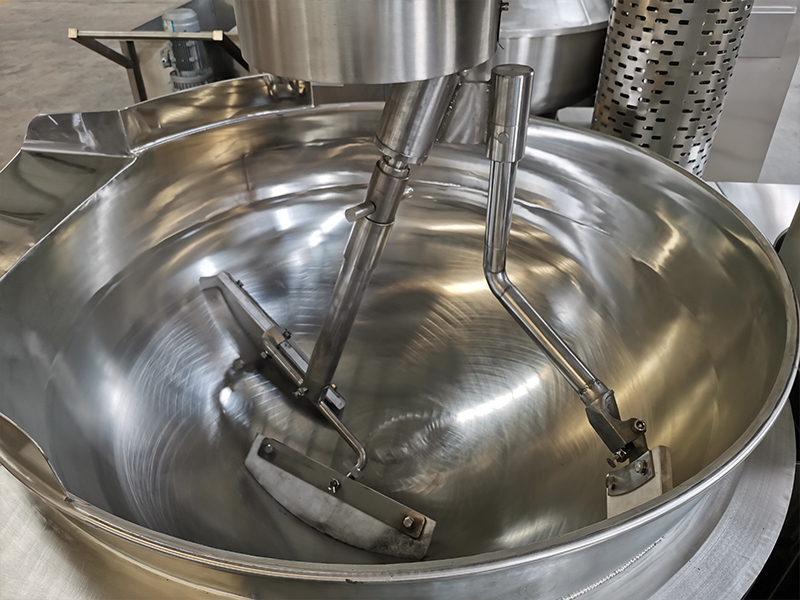
Spring-loaded PTFE blades follow the bowl contour, including the curved transition at the base, so no static layer survives long enough to burn.
Heat moves from the jacket into the sauce through a boundary layer that is almost stationary. In a viscous product that layer is where starch and protein denature and stick. A scraper that sweeps the entire wetted contour — wall, base radius and centre — removes the layer before it can carbonise and folds it back into the bulk. Scraping only the flat bottom, which is what a simple anchor agitator does, leaves the curved transition uncovered, and that ring is where burnt specks appear first.
The agitator is the part of an industrial sauce making machine that is genuinely difficult to change later, so it is worth understanding the three common layouts before comparing quotations.
Table 2. Agitation architecture compared
| Layout | How it moves product | Best fit | Limitation |
|---|---|---|---|
| Planetary (dual-axis) | Paddles orbit the bowl while rotating on their own axis; scrapers track the wall | Chili oil, ketchup, glazes, sauces with moderate solids | Very thick pastes can overload the orbit drive |
| Multi-claw | Several reinforced arms tear through high-resistance mass | Bean paste, hotpot base, dense particulate sauces | More shear than a planetary head at the same speed |
| Horizontal (U-shaped) | Horizontal shaft with paddles lifts and folds along a trough | Very high viscosity pastes, jams, fillings | Less suitable for thin, oil-continuous products |
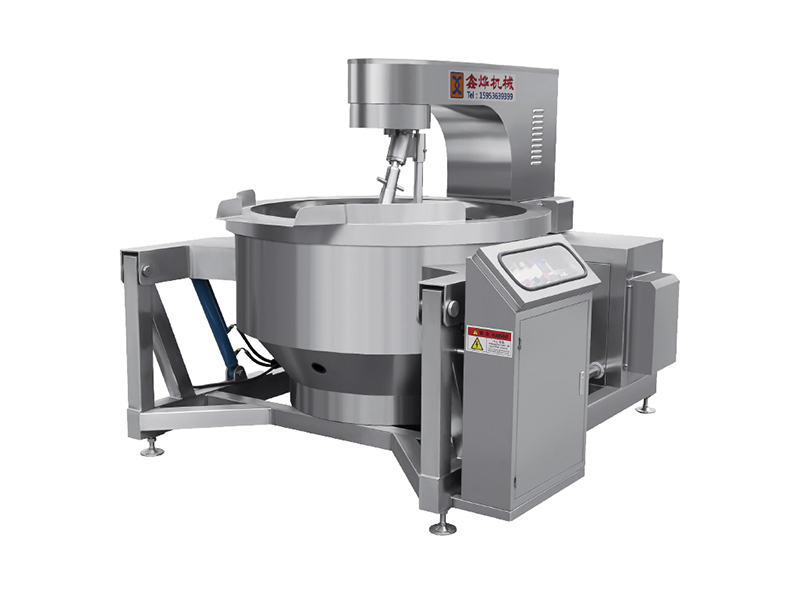
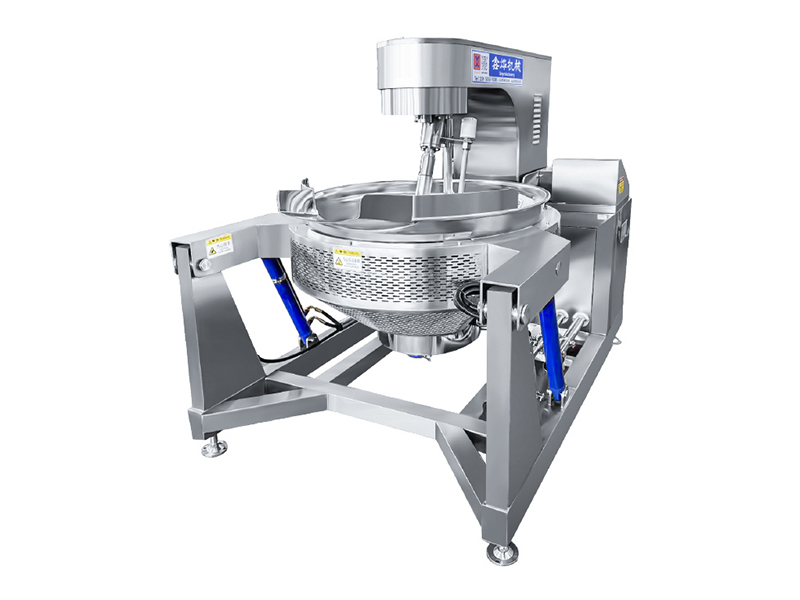
The equipment range follows the same split: planetary cooking mixers for oil-based and medium-viscosity sauces, multi-claw cooking mixers for dense paste, and horizontal cooking mixers for product that will not fold in a round bowl. Comparing quotations across the three is only meaningful once the product has been placed in one of them.
Most sauce defects that reach the customer are texture defects, and most texture defects come from running the agitator too fast. A variable-frequency drive that holds 10–18 rpm lets broad paddles tumble solids through the liquid rather than cutting them. The same machine at 40 rpm will produce a smoother sauce in less time and destroy the particulate that justified the price premium.
The discharge mechanism is usually the last item on an industrial sauce making machine specification sheet and the first one operators complain about. A high-pivot hydraulic tilt lifts the vessel forward and past vertical, so a 60,000 mPa·s paste slides out under its own weight into a 200 L bin or a positive-displacement pump. Suppliers who quote a tilt angle without the pivot height are quoting a number that may not clear your receiving container.
The three machines below cover the three architectures in the table, from a compact planetary unit for a first line to a horizontal mixer for paste that will not pour.
A quotation that lists only volume and power is not a specification. The items below are the ones that decide whether the machine fits the product, and each can be checked before the deposit is paid. A longer set of selection criteria, including the questions worth asking a supplier, is set out in this buyer's guide to industrial sauce mixers.
Working capacity, not gross capacity. The usable batch is usually 70–80% of the nominal volume; the rest is headspace for foam and boil-up.
Temperature range at the wall, not at the probe. A 260 °C claim is only meaningful if the burner output and the scraper contact pressure are specified with it.
Agitator torque at the lowest speed. Viscosity peaks during starch activation, and that is the moment a marginally sized motor trips.
Scraper material and replacement interval. Food-grade PTFE is a wear part, not a permanent fitting.
Surface finish and weld treatment. Ra ≤ 0.4–0.6 µm on wetted surfaces, with ground and polished welds.
Documentation package. Material certificates, pressure test records, electrical schematics and a pre-shipment test video.
Wear-part supply. Scraper blades, seals and sensors are consumables; confirm the lead time and whether they are held in stock or made to order.
Capacity is where first-time buyers over-commit. A 1,200 L industrial sauce making machine looks like a better investment than a 300 L one until the working capital tied up in ingredients, jars and labels is counted, and until the day the line runs at 30% of capacity because distribution has not caught up. The sizing question is not "how much can this machine make" but "how much can I sell before it spoils".
Start with the number of retail doors, the units each door turns per week, and the shelf life of the product. A sauce with a nine-month shelf life can be produced in campaigns; a fresh-style sauce with three weeks cannot. Campaign production lets one vessel serve several SKUs; continuous production forces a second vessel or a larger one. Both are legitimate, but they produce very different capacity requirements from the same sales forecast.
Vessel volume is not batch weight. A 1,000 L vessel typically runs 700–800 kg of sauce, because the headspace is needed for foam, boil-up and the volume the agitator displaces. Batch weight then divides into the day's target, and cycle time — heat-up, hold, cool, discharge, clean — sets how many batches fit into a shift. Three batches of 750 kg in an eight-hour shift is 2.25 tonnes, which is a very different number from the one the litre figure suggests. The arithmetic behind working batch, rated capacity and realistic output is set out in this guide to sizing a steam kettle with agitator.
The heat source sets the ceiling on what the machine can cook, and it also sets the utility work the site needs before installation. Steam requires a boiler and a pressure system; gas requires flue routing, ventilation and a gas safety certificate; thermal oil requires a heater package and a larger footprint.
Table 3. Heat source comparison for sauce production
| Heat source | Practical ceiling | Strongest fit | Site requirement |
|---|---|---|---|
| Saturated steam (jacket 0.2–0.4 MPa) | About 133–152 °C at the wall | Tomato sauces, gravies, dairy-based and sugar-sensitive recipes | Boiler, water treatment, pressure vessel inspection |
| Infrared pre-mix gas | Up to 260 °C | Chili oil, curry paste, aromatics, hotpot base | Gas supply, flue, ventilation, fire safety |
| Thermal oil | Up to 260 °C and above | High-temperature recipes where open flame is not permitted | Oil heater, expansion tank, larger floor area |
| Electric induction | Typically up to about 200 °C | Clean rooms, sites with no gas or boiler allowance | Substantial electrical capacity |
Suppliers often quote a gas saving against atmospheric burners — around 20% is a common figure. Treat it as a claim until the test basis is supplied: burner efficiency, vessel size and flue losses all move the number, and the comparison is only valid at the same duty.
On the steam route, the jacket is only half of the system. How the condensate leaves the jacket, how the pressure is controlled and how evenly heat reaches the wall decide whether a batch cooks evenly or scalds at one side; the mechanism is explained in this guide to how steam jacketed kettles are heated.
Industrial sauce making machines are usually offered in two build bands, and the mechanical differences between them matter more than the litre rating. The compact band covers pilot and small commercial production; the heavy-duty band is built for multi-shift duty and thicker product.
Table 4. Specification bands for an industrial sauce making machine
| Parameter | Compact and mid-scale (100–500 L) | Heavy-duty (600–1,200 L) |
|---|---|---|
| Heating options | Saturated steam, infrared gas, thermal oil | Dual-jacket steam, infrared pre-mix gas, thermal oil |
| Thermal range | Ambient to 120 °C steam, up to 260 °C gas | Ambient to 120 °C steam, up to 260 °C gas or oil |
| Jacket pressure | 0.2–0.4 MPa | 0.2–0.4 MPa, hydrostatically tested to 0.6 MPa |
| Agitation | Dual-motion orbital planetary scraping | Multi-claw reinforced planetary system |
| Agitator speed | 0–36 rpm, stepless inverter | 0–45 rpm, helical gear drive |
| Drive rating | 1.5–4.0 kW | 5.5–11.0 kW |
| Discharge | Hydraulic tilt to 90° | High-pivot hydraulic pouring |
| Wetted metal | SUS304, optional SUS316L | SUS304, optional SUS316L |
| Surface finish | Ra ≤ 0.6 µm | Ra ≤ 0.4–0.6 µm |
| Compliance | CE Machinery Directive, IP65 control | CE Machinery Directive, IP65 control panel |
Values above are the manufacturer's published bands for the two build standards. Confirm the exact configuration against your own product data before ordering, because heating options and agitation type are selected per order.
The vessel is the centre of a sauce plant, not the whole of it. A first line usually needs five supporting elements, and leaving any of them out of the capital plan is how projects run 30% over budget.
Fresh onion, garlic and chili need washing, sorting and size reduction before they reach the vessel. A crusher or colloid mill turns solids into a pumpable slurry and shortens the cook; a dicer keeps particulate intact where the product calls for visible pieces. For fruit and vegetable bases, a pulper removes seed and skin that would otherwise become a defect in the finished sauce.
Hot fill at 85–92 °C requires a filler rated for that temperature, heat-resistant containers, and a capping system that pulls a vacuum as the product cools. Viscous sauce fills slowly, so the filler's speed is usually the bottleneck once the vessel is running at capacity. Piston fillers handle particulate better than gravity fillers; servo-driven auger fillers are more accurate on small jars.
If the product is not hot-filled, a tunnel pasteuriser or a water-bath line provides the heat treatment after sealing, followed by progressive cooling to avoid thermal shock to the glass. This stage is often added a year after launch, when a retailer asks for a longer shelf life — planning the floor space for it now costs nothing.
Label content is regulated, and the layout has to be approved before the print run. Batch coding, best-before dates and, in many markets, allergen and nutrition panels are mandatory. A label that has to be reprinted because the ingredient order changed is a five-figure mistake at retail volumes.
Changeover cleaning between a chili product and a tomato product is a food-safety control, not a housekeeping task. Open-top vessels with a cantilevered drive and no submerged shaft seals clean faster, because there is no hidden cavity for residue to collect. Budget for hot water capacity, a drain route and a documented cleaning record from the first day.
Food regulation is not a single approval at the end of a project; it is a set of decisions taken during product design, and several of them constrain the equipment. The three that catch first-time producers are product classification, the hygiene system and the label.
The first regulatory question is whether the sauce is acidified (pH 4.6 or below) or a low-acid product. Acidified foods follow a defined process with a scheduled process and, in most jurisdictions, a qualified process authority; low-acid canned foods face stricter thermal-process validation. The classification determines the required heat treatment, the records you must keep and, in some cases, whether the vessel needs a pressure-rated jacket. Regulatory guidance on acidified and low-acid canned foods sets out how the two categories are defined and what a scheduled process has to contain.
HACCP, ISO 22000 or a national equivalent all rest on the same logic: identify the biological, chemical and physical hazards, then control them at a step you can monitor. In a sauce plant the critical control points are usually the thermal process, the fill temperature, the seal integrity and metal detection. The general principles behind those controls are codified in the international code of practice for food hygiene, and preventive-control requirements in the United States are summarised under the food safety modernisation rules. Both reward documentation written before the first batch, not after.
Ingredient declarations are ordered by weight, which means a recipe change can force a reprint. Allergen declarations, nutrition panels and any health or origin claim are separately regulated, and the requirements of the destination market apply, not those of the factory. The framework for food labelling and nutrition claims is a useful reference point even for exporters selling elsewhere, because retail buyers tend to ask for equivalent information regardless of jurisdiction.
A CE declaration of conformity, material certificates for the wetted parts, hydrostatic test records for pressurised jackets, electrical schematics and a factory acceptance test record are the documents an auditor or a retail customer's technical team will ask for. They also protect the buyer commercially: a machine supplied without a material certificate cannot be shown to be SUS304 rather than a generic 200-series stainless. How the equipment is built and documented is described in the manufacturing and quality control process behind these machines.
Sauce businesses rarely fail because the machine was too expensive. They fail because the cost per kilogram was never calculated, and the price was set by looking at competitors. The table below shows the structure of a cost build-up for 1,000 kg of finished sauce; the figures are an illustrative example, not a market quotation, and every line should be replaced with your own numbers.
Table 5. Illustrative cost build-up per 1,000 kg of finished sauce
| Cost line | How it is calculated | Example value (USD) | Share |
|---|---|---|---|
| Ingredients | Recipe cost per kg × input weight, including water loss | 1,850 | 66% |
| Packaging | Jars, caps, labels, cartons at your order quantity | 420 | 15% |
| Energy | Gas or steam, electricity, CIP hot water | 45 | 2% |
| Direct labour | Operators, QC, cleaning, at loaded hourly cost | 165 | 6% |
| Overhead and depreciation | Rent, machine depreciation, maintenance, compliance | 260 | 9% |
| Yield and changeover loss | Rejects, heel, changeover flush, at 3% of material cost | 68 | 2% |
| Total ex-works cost | Sum of the lines above | 2,808 | 100% |
| Gross margin at USD 3,600 per 1,000 kg | (Revenue − cost) ÷ revenue | 792 | 22% |
Yield. A three-point difference in yield on a 1,000 kg batch is 30 kg of product, which is usually worth more than the difference between two machine quotations.
Changeover loss. Every SKU switch costs a flush and a cleaning cycle. A plant with eight SKUs and weekly changeovers loses more to changeover than to any single ingredient price movement.
Price per kilogram against ingredient cost. If ingredients are two thirds of the selling price, the business has no room for a bad batch. Recipes with a lower ingredient share tolerate learning curves far better.
Energy deserves a note because it is usually overestimated. Heating a tonne of sauce to simmering and reducing it modestly consumes far less gas than founders expect; the machine's own electricity draw is small next to the compressor, the chiller and the lighting. Energy is rarely the line that decides whether a sauce business works, which is why paying a premium for an efficiency claim without a test basis is usually a poor trade.
A single industrial sauce making machine needs one operator per shift once the process is documented, and that operator can usually supervise two or three machines where they are grouped. The first ninety days are not production, though; they are commissioning, and planning them as production is the most common scheduling error.
Allow two to four weeks for installing and profiling an industrial sauce making machine on water before any real ingredient is cooked. The purpose is to establish, for each recipe, the burner or steam setting, the agitator speed at each stage, the time to reach each temperature and the cooling rate. Those numbers become the batch record; without them, every batch is a new experiment and consistency depends on the operator's memory.
A batch record with times, temperatures, speeds and weights is what makes a sauce reproducible, and it is also the first thing a retail buyer's auditor asks to see. Write it during commissioning, not after the first complaint. The same record is what lets a second shift produce an identical product without retraining from scratch.
Two products with different allergen profiles cannot share a vessel without a validated cleaning step. Sequence production so that mild products run before pungent ones, and that allergen-containing recipes run last in the week. This single scheduling rule reduces cleaning time and cross-contamination risk at the same time.
The same five defects appear in almost every new sauce plant, and none of them is caused by a defective machine. They are operating errors that a written process prevents.
No thermal profile. The operator judges temperature by eye and the batch is cooked to a different end point every day. Fix: record set points and times for each recipe during commissioning.
Overfilled vessel. Running a 1,000 L industrial sauce making machine at 950 L leaves no headspace, so the batch foams over and the agitator cannot fold the surface back in. Fix: define the working batch and mark it on the vessel.
Acid added at the start. Acid in the first ten minutes hydrolyses starch before it has built viscosity, and the sauce never thickens properly. Fix: add acid in the final stage and check pH on the finished batch.
Agitator run too fast. Particulate is sheared into paste and the product loses the texture the recipe was designed around. Fix: fix the rpm for each stage in the batch record, not just a maximum.
Packaging specified too early. Containers bought before the fill temperature was confirmed distort at 88 °C or fail the vacuum test. Fix: confirm the fill temperature first, then specify the jar.
The first two are thermal problems and the fourth is a mechanical one, but all five share a single root cause: the process was never written down. A guide to cooking tomato paste without scorching the base walks through the same failure in a single product, and the logic transfers to any starch- or sugar-thickened sauce.
Growth in this category rarely arrives as one big step. It arrives as a second shift, then a second SKU, then a second vessel, and each stage changes the constraint. Planning the sequence in advance avoids buying the wrong machine twice.
Up to about 1 tonne a day. One industrial sauce making machine, manual filling, one shift. The constraint is usually the cook cycle, and the cheapest capacity gain is a second shift, not a bigger machine.
One to three tonnes a day. Two vessels or a larger one, a semi-automatic filler and a proper cleaning routine. Changeover time becomes the constraint, so recipes are grouped by allergen and colour.
Three to five tonnes a day. Vessels run in parallel with a buffer tank, filling moves to an automatic line, and the constraint moves to packaging and warehouse space. This is where a sauce production line with PLC control and integrated filling starts to pay for itself.
Above five tonnes a day. Continuous or semi-continuous processing, in-line viscosity measurement and automated recipe management. At this scale the vessel is no longer the expensive part of the plant.
Product range grows in parallel. A plant that starts with one chili sauce usually adds a second viscosity class within two years, which is why the sauce and condiment processing range and the paste and filling equipment are specified as a family rather than as single machines: a vessel bought for one product should not become useless when the second one launches.
A third route sits alongside own-brand growth: making sauce for other brands. Contract and private-label work fills capacity between campaigns, and it changes the specification, because the machine then has to handle the widest range of products a client list brings rather than one recipe optimised over years. Plants that expect to take on this work usually choose a wider thermal range and a more flexible agitator than their own product strictly needs.
Planning a sauce line and not sure which capacity to buy?
Send the product, the target output per shift and the packaging format. The reply is a machine recommendation, the auxiliary list and the utility requirements as one document.
Get a QuoteContact UsStarting a sauce business is a sequence of engineering decisions disguised as commercial ones. The product has to be defined in viscosity, particle size and pH before a supplier can quote; the thermal stages have to be matched to a heat source that can actually reach them; the vessel has to be sized against sellable volume rather than ambition; and the compliance file has to be written before the first batch rather than after the first inspection.
An industrial sauce making machine sits at the centre of all four. It is the one purchase that determines what the plant can cook, how consistent the output is, how much labour the line needs and how quickly a changeover can happen. Getting that specification right costs a few weeks of preparation; getting it wrong costs a second machine.
XINYE builds planetary, multi-claw and horizontal cooking equipment for sauce producers, with the thermal range, scraping system and discharge matched to the product rather than to a catalogue slot. If you are sourcing a reliable industrial sauce making machine manufacturer, send the product specification and the target output, and the engineering team will come back with a configuration, the utility requirements and the documentation package.
Tell us the sauce, the output and the packaging
Product viscosity, target kilograms per shift and container format are enough to size a line. Ask for a configuration sheet and a quotation with the auxiliary equipment included.
Get a QuoteContact UsAn industrial sauce making machine is only part of the figure. A first line also needs pre-processing, a filler, a capper, labelling and the utility connections, plus working capital for ingredients, packaging and the stock a distributor will demand. Because machine prices move with heating method, capacity and agitation type, the reliable approach is to size the line from the sales forecast first and then request quotations against a fixed specification.
Size from sellable volume, not from the largest vessel in the catalogue. Estimate kilograms per shift from the number of retail doors and their turnover, divide by the working batch weight (roughly 70–80% of nominal volume), then check how many batches fit into a shift at your cook cycle. A machine running at 60–80% of capacity is efficient; one running at 25% ties up capital in stainless steel and in stock.
Often yes, if the heat source reaches both temperature bands and the agitator suits both viscosities. Chili oil needs 160–260 °C at the wall, which rules out a steam-only jacket; ketchup needs gentle, evenly scraped heat at 85–105 °C. A dual-purpose machine is normally specified with gas or thermal oil heating and a variable-speed planetary agitator, and the two recipes run as separate validated processes with a cleaning step between them.
Mechanical installation and utility connection typically take one to two weeks, followed by two to four weeks of thermal profiling and trial batches before commercial production. Steam installations add boiler commissioning and pressure-system inspection, which can extend the schedule. Sites that prepare the floor, drainage, gas supply and electrical capacity before the machine arrives usually halve the delay.
It depends on the hottest step in the recipe. Steam at 0.2–0.4 MPa reaches roughly 133–152 °C at the jacket, which is enough for tomato sauces, gravies and dairy-based recipes and is the gentlest option for sugar. Gas and thermal oil reach 260 °C for spice blooming and chili oil. Sites without a boiler or a gas allowance often choose thermal oil or induction instead.
At minimum: a CE declaration of conformity where applicable, material certificates for the wetted parts, hydrostatic test records for any pressurised jacket, electrical schematics, an operation and maintenance manual, a spare-parts list and a factory acceptance test record or video. These documents are needed for food-safety audits and for any later resale of the equipment.
1. Definitions and process requirements for acidified and low-acid canned foods: acidified and low-acid canned food guidance.
2. General principles of food hygiene and codes of practice: international food hygiene codes.
3. Preventive-control and food safety modernisation requirements: food safety modernisation rules.
4. Food labelling and nutrition claim requirements: food labelling and nutrition guidance.
Cost figures in Table 5 are an illustrative calculation, not a quotation or a market average; every line should be replaced with the reader's own supplier and recipe data. Machine specifications quoted in Table 4 are the manufacturer's published bands for the two build standards.

 Phone:0086-15908033216
 E-mail: olivia.xinye@gmail.com
 Whatsapp/WeChat: +86 15169588915
 ADD: No.78, Jianqiao Road, Shunwang Sub-district, Zhucheng City, Weifang City, Shandong Province
Customer Message
Designed by Zhonghuan InternetCopyRight © 2026 ZHUCHENG XINYE MACHINERY CO., LTD. All rights reserved All tags Sitemap