



Scorching is the most common quality failure in tomato paste production. A batch that smells fine at the start can develop a bitter, caramelized layer on the kettle bottom within minutes, turning an otherwise bright red concentrate into an off-spec product. The problem is rarely the recipe itself; it is almost always a mismatch between the equipment, the viscosity of the product, and the way heat is delivered. This guide explains why scorching happens, how the geometry of a Horizontal Mixer changes the heat-transfer problem, and what practical parameters production teams should control when concentrating tomato paste at industrial scale.
Key Takeaways
Scorching occurs when the wall temperature exceeds the thermal tolerance of tomato solids faster than agitation can remove product from the wall.
As tomato paste thickens from roughly 5°Brix to 24–30°Brix, its viscosity rises sharply, which reduces natural convection and increases the risk of local overheating.
A horizontal cooking Mixer with a U-shaped trough and low-speed wall-scraping agitator keeps product moving along the heated surface without shearing it apart.
Vacuum operation drops the boiling point to 60–80°C, which helps preserve the natural red color and volatile aroma compounds.
Target Brix, jacket temperature, agitator speed and batch size should be set as a matched set, not chosen independently.
1. What Tomato Paste Actually Is
Tomato paste is a concentrated product made by removing water from tomato pulp. The legal definition in many markets sets a minimum soluble-solids threshold; in the U.S. regulation, tomato paste must contain not less than 24.0 percent tomato soluble solids, while tomato puree sits lower in the range. Buyers in the trade commonly refer to double concentrate (around 28–30°Brix) and triple concentrate (around 36–38°Brix), depending on end use. The higher the Brix, the higher the viscosity, and the harder the material is to cook without burning on the bottom.
Fresh tomato pulp typically enters the concentration step at about 4.5–5.5°Brix. Reaching 28–30°Brix means removing roughly 80 percent of the water by mass. During that journey the product changes from a pourable juice to a dough-like mass, which is exactly why a kettle designed for thin liquids is often no longer suitable in the final stage.
2. Why Tomato Paste Scorches on the Bottom
Scorching is a heat-transfer problem, not a seasoning problem. In a steam-jacketed vessel, heat flows from the steam wall into the product. As long as the product near the wall moves away and fresh, cooler product takes its place, the wall stays clean. When that circulation stops, a thin film of product sits against the hot wall long enough to caramelize or burn.
Three factors make tomato paste especially vulnerable:
Rising viscosity. As water leaves, the paste thickens. Natural convection weakens, so the layer near the wall no longer refreshes itself quickly.
Sensitivity of color and flavor compounds. Lycopene and volatile tomato aromas degrade at sustained temperatures well below the point where actual charring is visible. A batch can taste "cooked" before it looks burnt.
Residence time on the wall. In tall vertical kettles, the bottom corner is often the slowest-moving region. Heavy paste tends to accumulate there, where it receives the most heat.
3. Why Vertical Kettles Struggle with High-Viscosity Paste
A standard vertical cooking kettle works well for thin sauces and broths because a central paddle can circulate the bulk liquid. But as viscosity climbs, that same paddle moves the material in the center of the tank while the product near the jacketed wall and in the bottom annulus barely moves. Operators respond by raising steam pressure, which raises the wall temperature further, which accelerates scorching. Motor overloads and burnt bottom layers are the typical symptoms.
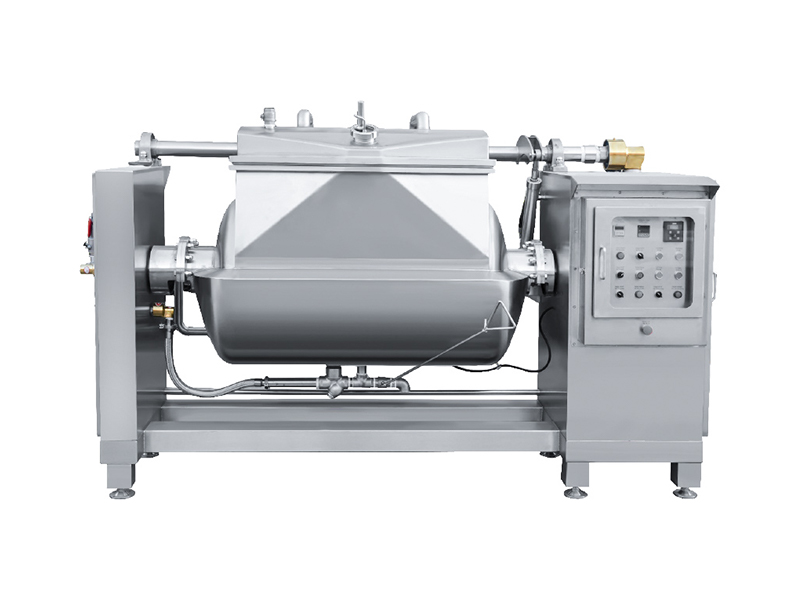
This is where the geometry of a Horizontal Mixer changes the dynamics. A horizontal trough places the agitator across the full length of the heated surface rather than in the center of a deep cylinder. Low-speed blades, often with wall-scraping profiles, continuously wipe fresh product across the jacket. Because the drive shaft is horizontal, the machine can apply higher torque at low rpm, which is exactly what a viscous, dough-like material needs instead of high-shear mixing that would destroy texture. In other words, a well-matched horizontal mixer removes the stagnant wall layer that causes scorching in the first place.
4. How a Horizontal Cooking Mixer Prevents Scorching
A well-designed horizontal cooking Mixer for tomato paste concentrates heat removal around four design points:
U-shaped trough. The heated surface wraps around the lower half of the product, so there is no deep, stagnant bottom corner.
Low-speed horizontal agitation. Typical agitator speeds of roughly 8–25 rpm fold the product rather than whipping it. This keeps the wall layer refreshed without aerating the paste.
Wall contact clearance. Blades or scrapers running close to the inner wall continuously remove the film that would otherwise overheat.
Controllable jacket. Steam or hot water jacketed heating lets operators cap the wall temperature instead of running at maximum pressure.
For premium tomato products, a vacuum variant of the same machine lowers the internal pressure so that water boils at 60–80°C instead of 100°C. At those temperatures the paste still evaporates, but the thermal stress on color and aroma is substantially reduced. Vacuum concentration also shortens the high-temperature hold time, which is the single largest contributor to dark, cooked-off flavor.
5. Recommended Process Parameters
There is no single perfect recipe; parameters shift with tomato variety, incoming Brix and target product. The table below gives a practical starting range that production teams can tune on their own line.
| Parameter | Starting Range | Why It Matters |
|---|---|---|
| Incoming pulp Brix | 4.5–5.5°Brix | Determines how much water must be removed |
| Target double concentrate | 28–30°Brix | Standard for ketchup, sauces, sachet paste |
| Target triple concentrate | 36–38°Brix | Higher shipping-value product; demands more torque |
| Product temperature (atmospheric) | 80–95°C | Below this, evaporation is slow; above, color degrades |
| Product temperature (vacuum) | 60–80°C | Locks in red color and volatile notes |
| Jacket steam pressure | 0.2–0.3 MPa (gauge) | Lower pressure = lower wall temperature = less scorching risk |
| Agitator speed | 8–25 rpm | High speed adds heat and shear, no benefit at high viscosity |
| Batch size | 300–1000 L typical | Sized to match the torque and jacket area of the mixer |
6. A Practical Batch Procedure
Preheat gently. Start with low jacket pressure while the pulp is still thin. High initial heat on a thin product can burn on the wall before agitation has built up circulation.
Hold at temperature, don't chase pressure. Once the product reaches the target range, hold it steady. Fluctuating jacket pressure is a common cause of a brown layer on the wall.
Watch Brix, not time. Use a refractometer at intervals. Clock times are misleading because incoming Brix varies season to season.
Slow the agitator as viscosity rises. The thicker the paste, the lower the safe speed. High rpm at 30°Brix wastes energy and adds unwanted shear.
Empty early, not late. Transfer the batch while it is still fluid. Over-concentrating inside the mixer makes discharge and cleaning harder.
Clean immediately. Dried tomato residue on the wall will become the scorch seed for the next batch.
7. Troubleshooting Common Symptoms
| Symptom | Likely Cause | Adjustment |
|---|---|---|
| Brown layer on the bottom after batch | Wall temperature too high; weak wall wiping | Lower jacket steam pressure; verify scraper clearance |
| Dark red, dull color instead of bright red | Too long above 90°C; no vacuum | Switch to vacuum operation; shorten hold time |
| Motor overload or stalling | Viscosity exceeds mixer torque; speed too high | Reduce rpm; confirm motor size matches target Brix |
| Uneven Brix across the batch | Dead zones in the vessel | Check agitator coverage and loading level |
| Bitter, cooked-off flavor | Prolonged high-temperature exposure | Lower product temperature; speed up evaporation under vacuum |
| Foaming over during vacuum pull | Rapid pressure drop on low-Brix material | Pull vacuum gradually; use defoamer only if approved by the recipe |
8. What to Look for When Sourcing a Tomato Paste Processing Machine
When evaluating a tomato paste processing machine, buyers should separate "cooking vessel" from "concentration solution." A few practical checks when comparing any horizontal cooking mixer on the market:
Confirm the motor torque and gearbox are rated for the final Brix, not the starting pulp. Vendors often quote power at low viscosity, which is misleading.
Ask whether the agitator clears the wall evenly across the full trough length. A visible gap means a dead zone.
Check jacket rating. A machine rated only for thin sauces may not deliver stable wall temperature at 30°Brix.
Decide early whether vacuum is required. Vacuum doubles the capital cost but is often the only reliable way to hit premium color specs.
Plan cleaning access. A machine that cannot be fully washed after a tomato batch will contaminate the next product.
Looking for a Reliable Horizontal Cooking Mixer Manufacturer?
Xinye engineers build U-trough horizontal mixers in 300 L to 1000 L capacities, with optional vacuum and condenser upgrades designed for high-viscosity pastes including tomato concentrate. Share your target Brix, batch size and heating medium for an equipment match.
Request a Quote Today9. Summary
Scorching in tomato paste is not a mystery. It happens when heat reaches the vessel wall faster than the product is moved away from it. A Horizontal Mixer addresses the root cause by combining a U-shaped trough, low-speed high-torque agitation and wall-scraping blades, while a vacuum option adds a second layer of protection for color and flavor. By controlling jacket temperature, agitator speed and Brix as a matched set, production teams can hit 28–30°Brix or even 36–38°Brix without the brown bottom that ruins the batch. The equipment investment pays back in rework reduction, yield and a consistent red color that buyers expect from a commercial tomato paste processing machine built on a reliable horizontal cooking mixer platform.
Frequently Asked Questions
What temperature should tomato paste be cooked at to avoid scorching?
Aim for a jacket-controlled temperature below 105°C and a product temperature held at 80–95°C at atmospheric pressure, or 60–80°C under vacuum. The critical variable is the gap between wall and product temperature, not a single setpoint.
What Brix level qualifies as tomato paste?
Under the U.S. standard of identity, tomato paste must contain at least 24.0 percent tomato soluble solids. Commercial double concentrate typically runs 28–30°Brix and triple concentrate 36–38°Brix. The regulatory definition and USDA grade criteria are useful references for buyers.
How long does it take to concentrate tomato paste in a horizontal mixer?
For a 500 L batch starting near 5°Brix and finishing at 28–30°Brix under vacuum, a typical cycle is around 1.5–3 hours. Actual time depends on jacket steam pressure, vacuum level and starting Brix, so always confirm end point by refractometer.
Is vacuum cooking necessary for tomato paste?
It is not mandatory, but vacuum lowers the boiling point to roughly 60–80°C, which reduces browning and preserves aroma. Atmospheric cooking is acceptable for industrial double concentrate where color tolerance is looser.
Can a horizontal mixer handle both double and triple concentrated tomato paste?
Yes, provided torque, gearbox and agitator design are sized for the highest target viscosity. Triple concentrate (36–38°Brix) is significantly thicker than double concentrate and will overload an undersized machine.
How do I clean a horizontal mixer after tomato paste production?
Empty while fluid, flush with warm water, run an alkaline cleaning cycle at the supplier-recommended temperature, then rinse and inspect the wall, agitator and shaft seal for dried residue. For food-safety planning, established food-preservation guidance on prompt processing and cleaning remains a useful baseline.

 Phone: