





News Categories

Chili sauce looks simple in a jar: peppers, oil, salt, acid, and perhaps garlic or starch. Making it by the ton is a different problem. The gap between a kitchen batch and factory output is not a larger pot, but a controlled sequence of heat, shear, and time, held steady by a chili sauce making machine from one batch to the next. This guide follows that sequence stage by stage and shows which parameters decide whether the finished sauce stays red, thick, and shelf-stable.
Factory chili sauce production follows five stages: preparation, oil infusion, water-phase blending, concentration, and hot fill.
Oil infusion typically runs at 180°C to 240°C, water-phase blending at 85°C to 100°C, and hot fill at 85°C to 90°C for many acidified recipes.
The agitator must scrape the heated surface and keep dense flakes in suspension, or solids scorch within seconds.
Viscosity and particulate size determine whether a planetary cooker, a horizontal kneading mixer, or a jacketed kettle is the better fit.
A factory line is a chain rather than a single unit: washing, grinding, weighing, cooking, transfer, filling, and capping. The cooking vessel sits at the center because it sets the thermal history of the product. In most plants, a chili sauce making machine combines a heated vessel, an agitator, a temperature controller, and a discharge system. Upstream equipment fixes particle size; downstream filling fixes how long the sauce stays hot. A line works well when those three zones are matched. The wider sauce production line layout usually determines whether batches move by pump, gravity, or container.
Dried chilies are deseeded fully or partly, then crushed or milled. Fresh peppers are washed, blanched, or ground into a mash. Particle size matters in both directions: coarse flakes release aroma slowly and remain visible in the sauce, while fine powder colors oil quickly but scorches more easily. Many plants use a two-stage grind so the base carries both body and visible flakes. The ground pepper is then weighed into the cooker with oil, salt, sugar, vinegar, and spices against a fixed recipe.
The stages below describe a typical batch process for chili crisp, sambal, sriracha-style sauces, and similar products. Continuous lines rearrange the same unit operations, but the thermal logic does not change.
Oil is heated first. In this range, oil-soluble capsaicin and red carotenoid pigments move into the fat, while garlic, shallot, and dried spices lose their raw, sharp notes. This is where much of the flavor is built. The engineering risk is the boundary layer: chili flakes and seeds are denser than oil and sink toward the heated surface. Without continuous scraping, that layer can carbonize in seconds, leaving bitter notes and black specks through the batch. Cookers built for this duty use spring-loaded PTFE scrapers that follow the vessel contour, plus agitation that keeps solids suspended instead of resting on the hot wall.
Vinegar, pepper puree, water, and other aqueous ingredients go in next. The mass becomes an emulsion of oil, water, and solids. Too little shear leaves the phases separate in the jar; too much shear whips in air and creates foam that is difficult to fill. Planetary agitation folds the product along the wall and through the center, distributing the water phase without over-aerating. Variable-frequency drives let operators hold a middle speed band instead of running the motor flat out.
Many commercial sauces rely on starch, gums, or pectin-rich purees for cling. As water evaporates and starch gelatinizes, viscosity rises and heat transfer through the batch slows. A mixer that handled the oil stage easily can stall here, or leave a stagnant insulating layer against the wall. Heavy-duty gear reducers and wall-scraping agitators maintain torque and keep the whole mass moving so heat reaches the center, not just the jacket surface.
Share your batch size, target viscosity, and available steam, gas, or electric utilities to receive a matched equipment configuration and layout proposal.
Finished sauce is held in a narrow temperature band and transferred to filling while still hot. Hot fill uses the product's own heat to sanitize the container and closure, and it is widely used for acidified sauces. Transfer has to be fast enough to keep the product above its minimum fill temperature. A tilting cooker with an elevated pivot can empty into 200 L buggies or a positive-displacement pump hopper without manual scooping, which also removes a burn and contamination risk.
Two measurements frame the whole process: equilibrium pH and water activity. A product with a pH above 4.6 and water activity above 0.85 falls into low-acid territory and needs a different thermal process. Many chili sauces are formulated below pH 4.6, which is what allows a hot-fill approach. Operators record fill temperature, hold time, pH, and container seam integrity for every batch. In the United States, commercial processors of acidified foods must also register their establishment and file a scheduled process, as described in the guidance on acidified and low-acid canned foods.
Hot fill is not a substitute for formulation control. The heat load has to reach the coldest point of the container, and the holding time has to match the fill temperature. Extension guidance on the hot-fill-hold process for acid and acidified foods sets out the relationship between temperature and hold time, while a second extension guide to shelf-stable acidified foods explains why thick products and large particulates can be poor candidates for the method. A process authority should validate the scheduled process before a new recipe goes into production.
No single agitator suits every chili recipe. The choice turns on three variables: viscosity at the end of cooking, the size and fragility of solid pieces, and the heating utility available in the plant. The table below summarizes common configurations. Values reflect typical published machine specifications and should be confirmed against a specific model and process validation.
| Stage in a chili sauce making machine line | Viscosity and solids | Typical products | Heating options |
|---|---|---|---|
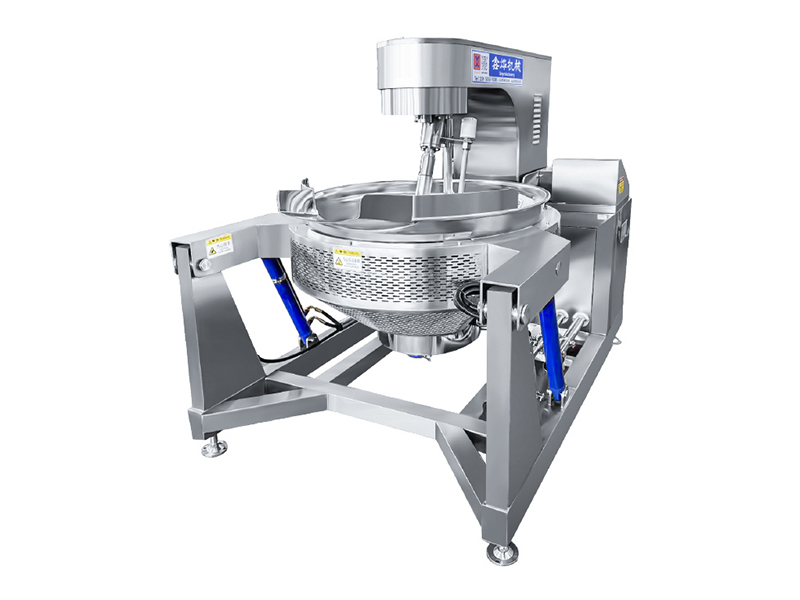
| Planetary tilting cooker | Medium to ultra-high viscosity, preserves 5 mm to 15 mm dice | Chili crisp, sambal, sriracha, barbecue sauce | Infrared gas, steam, thermal oil |
| Horizontal kneading mixer | Very high viscosity, dense fibrous pastes | Bean paste, curry roux, dense fruit fillings | Steam, thermal oil |
| Jacketed kettle with agitator | Low to medium viscosity, fine emulsions | Broths, light table sauces, soup bases | Saturated steam, electric elements |
For a batch cooker, the vessel size, agitator speed range, and discharge height matter as much as heating capacity. A unit with a 100 L to 1,200 L working volume and a 0 to 45 RPM inverter range covers pilot batches through industrial output, but the same frame may not suit a product with large particulates. Buyers comparing models should ask for the tested viscosity ceiling and the maximum particle size the agitator can fold without damage. Application notes for industrial sauce applications help narrow the choice before a specification is written.
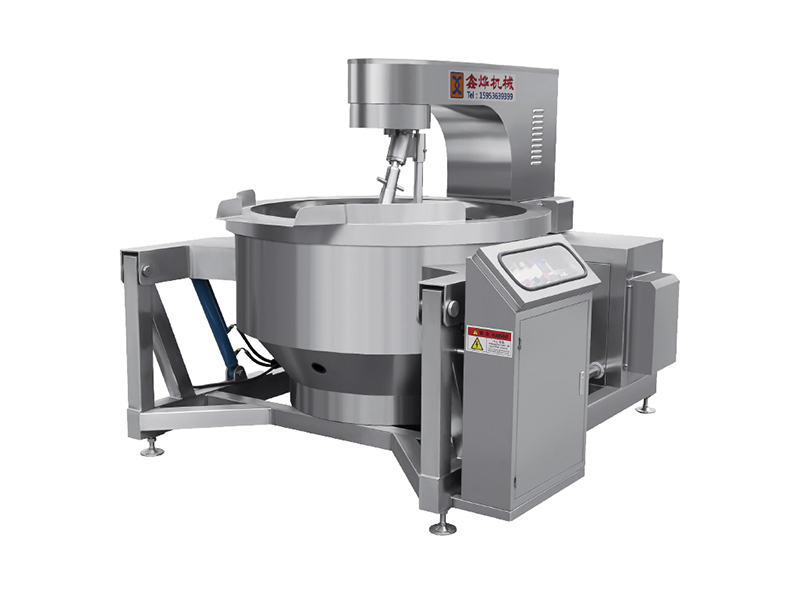
Jacketed cooking vessel with planetary PTFE scraping, infrared gas heating published to 260°C, and hydraulic discharge up to 90°.
View ProductReview vessel sizes, heating options, agitator speeds, and discharge configurations, or send a product sample for a process review.
Factory chili sauce is made by moving a formulated pepper base through controlled heating, shearing, concentration, and hot fill. Each stage has a narrow operating window, and the equipment has to hold that window when viscosity rises and solids settle. Vessel geometry, scraper contact, agitator torque, and discharge design matter more than a single temperature rating. Buyers who map their recipe against those variables can compare machines on process fit rather than brochure numbers.
For readers comparing chili sauce making machine manufacturers, XINYE provides published specifications, technical documentation and direct inquiry channels for further evaluation.
Batch time depends on vessel size, recipe, and target viscosity. Oil infusion and concentration are usually the longest stages. A 500 L to 1,000 L batch commonly takes a few hours from loading to discharge, with additional time for filling and cleaning.
Oil infusion and spice blooming typically run at 180°C to 240°C. Once aqueous ingredients are added, the mixture is held around 85°C to 100°C. Hot fill usually takes place at 85°C to 90°C, depending on the validated process.
Separation is usually a sign of insufficient emulsification, an unstable viscosity, or a fill temperature outside the validated range. Oil, water, and solids need enough shear during blending and enough solids or gum to hold the emulsion during storage.
Published models range from about 100 L to 1,200 L of working volume. Small plants often start with 200 L to 500 L vessels, while larger operations use multiple 1,000 L units or continuous lines. The right size depends on daily output, batch count, and available floor space.
Many acidified chili sauces rely on pH control, heat, and hot fill rather than added preservatives. The product must be formulated below the critical pH, filled within the validated temperature range, and checked for container integrity. The specific recipe still needs process validation.
Guidance on acidified and low-acid canned foods — definitions of acidified foods, pH 4.6 and water activity thresholds, establishment registration and process filing (fda.gov, accessed 2026-11-19).
Hot-fill-hold process for acid and acidified foods — temperature and hold-time relationship, container and closure handling (Kansas State University Extension, accessed 2026-11-19).
Producing shelf-stable acidified foods using hot-fill-hold — process steps and suitability limits for thick products and particulates (University of Georgia Extension, accessed 2026-11-19).
Data notes: vessel sizes, heating temperatures, agitator speeds, particulate range, and discharge angle are manufacturer-published figures for the Industrial Chili Sauce Making Machine and are not industry-wide values. Thermal-stage ranges and hot-fill conditions are general process guidance from the extension sources above and require validation for a specific recipe and container.

 Phone:0086-15908033216
 E-mail: olivia.xinye@gmail.com
 Whatsapp/WeChat: +86 15169588915
 ADD: No.78, Jianqiao Road, Shunwang Sub-district, Zhucheng City, Weifang City, Shandong Province
Customer Message
Designed by Zhonghuan InternetCopyRight © 2026 ZHUCHENG XINYE MACHINERY CO., LTD. All rights reserved All tags Sitemap