





News Categories

There are four main categories of commercial popcorn production equipment: kettle-type, hot-air, electromagnetic, and continuous production lines.
Each type differs significantly in output capacity, energy consumption, coating capability, and automation level.
Electromagnetic industrial popcorn making machines deliver the highest popping rate (98%+) and the most even caramel coating through planetary stirring.
Continuous production lines are the top choice for high-volume snack factories, reaching outputs of 200–800 kg/h.
Food safety compliance (SUS304 steel, CE certification, FDA equipment standards) is a non-negotiable baseline regardless of machine type.
The right choice depends on production scale, product flavor profile, budget, and available labor.
Popcorn appears to be a simple product — heat corn kernels until they pop. In reality, commercial popcorn production involves precise temperature control, even heat distribution, consistent seasoning application, and rapid throughput. A mismatch between machine type and production goal can result in a high rate of un-popped kernels (known in the industry as "old maids"), burnt sugar on caramel batches, or a bottleneck that limits daily output despite the rest of the factory running smoothly.
According to FDA Current Good Manufacturing Practice (CGMP) guidelines, food processing equipment must also meet strict design, material, and sanitation standards. Selecting equipment that is not built to these standards can create compliance issues and costly recalls further down the line.
With that in mind, here is a complete breakdown of each type of commercial popcorn production equipment.
The kettle machine is the most recognizable style — a rotating or tilting metal pot with an oil-based heating element at the bottom or sides. Kernels are placed inside with oil and heated until they pop. This is the traditional commercial method and remains widely used in cinemas, street food settings, and smaller snack businesses.
Oil is heated inside the kettle to around 180–200°C. Kernels are added and stirred by a motorized agitator as they pop. Once the batch is complete, the kettle tilts to dump finished popcorn into a warming deck below. The operator then resets and starts a new batch.
Low purchase cost and simple operation
Easy to clean and maintain
Flexible — suits frequent flavor changes
Good for small to mid-volume operations
Familiar technology with widely available spare parts
Batch-based — output limited to one cycle at a time
Uneven heat distribution leads to higher "old maid" rates (typically 5–10%)
Caramel and thick syrups are difficult to apply evenly
Labor-intensive — requires constant operator attention
Not suitable for outputs above ~100 kg/h
Best suited for: Cinemas, event venues, small snack shops, food trucks, R&D kitchens, and businesses just entering the popcorn market.
Hot-air machines pop kernels using superheated air rather than oil. Heated air is circulated through a chamber at high velocity, causing kernels to expand without direct oil contact. This method produces a lighter, lower-fat product that appeals strongly to health-conscious consumers.
An electric heating element or gas burner heats air, which is then forced through the popping chamber by a blower. The turbulent airflow keeps kernels moving, reducing scorching. Finished popcorn exits through a chute, while un-popped kernels are separated by weight or screen.
Oil-free or very low-oil production — ideal for "healthy" positioning
More consistent heat application than open-kettle designs
Lower oil cost and less smoke/residue during operation
Suitable for plain, lightly seasoned, or dry-flavored products
Easier to meet clean-label or organic certification requirements
Cannot produce caramel or wet-coated popcorn without a separate coating stage
Higher energy consumption from continuous blower motors
Flavor adhesion is weaker — dry seasonings may not bond well without added fat
Popcorn texture can be drier or less rich than oil-popped varieties
More complex airflow engineering means higher maintenance skill required
Best suited for: Health snack brands, organic popcorn producers, operations targeting low-fat or vegan-certified product lines, and export markets with strict ingredient labeling rules.
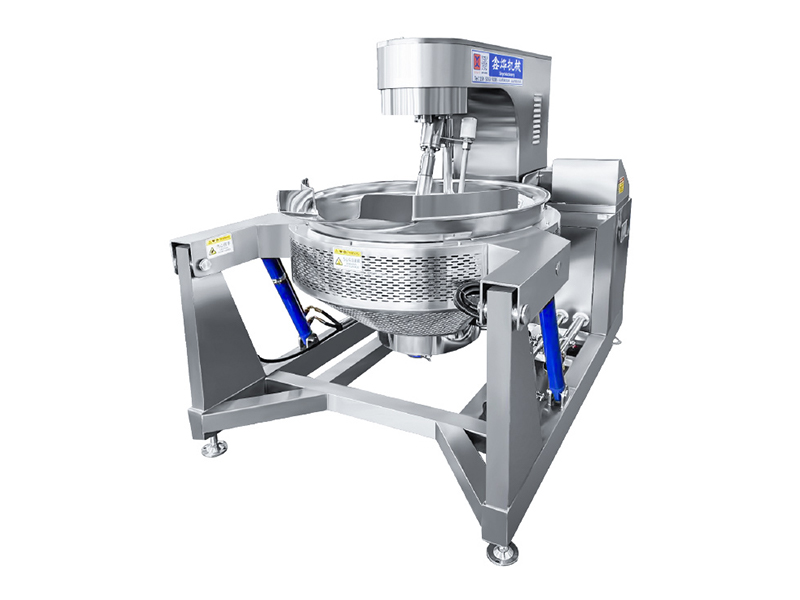
Electromagnetic machines represent a significant step forward from traditional kettle designs. Instead of relying on gas flames or immersion heaters, they use electromagnetic induction technology to heat the popping pot directly and almost instantaneously. This eliminates uneven hot spots and gives operators precise, real-time temperature control.
An electromagnetic coil generates a rapidly alternating magnetic field. When the metal popping pot passes through this field, electrical currents are induced in the pot itself, converting it into the heat source. This means every surface of the pot heats simultaneously, rather than from a single burner point. An integrated planetary stirring system continuously moves the kernels and any applied syrup or coating during and after popping, ensuring complete and even coverage.
Reaches target temperature (180–250°C) in seconds — extremely fast heat-up
Even, simultaneous heating eliminates hot spots and scorching
98%+ popping rate — near-zero waste from un-popped kernels
Planetary stirring system produces perfectly even caramel and syrup coatings
Precise PLC temperature control with digital monitoring
High energy efficiency — only heats the pot, not surrounding air
SUS304 food-grade stainless steel construction meets international hygiene standards
Can operate as a standalone unit or integrate into a full automated line
Higher upfront investment than basic kettle machines
Requires stable electrical supply (three-phase power typical)
Operators need brief training to use PLC controls effectively
Less suitable for very frequent, small-batch flavor changes without cleaning cycles
Best suited for: Mid-to-large snack manufacturers, caramel and gourmet popcorn brands, cinema chains with central production, and any operation where product quality consistency and waste reduction are priorities.
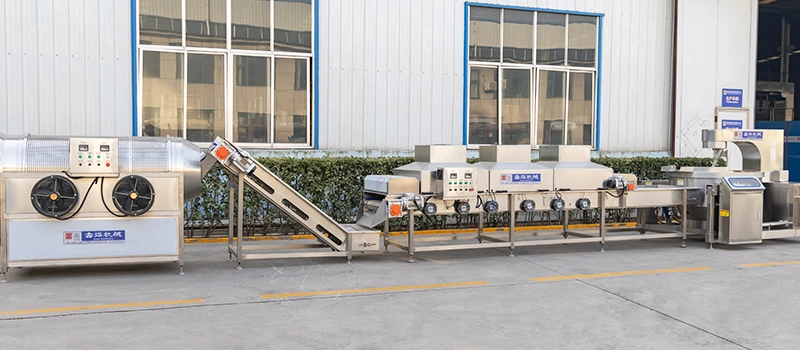
A continuous production line is not a single machine — it is a fully integrated system where raw kernels enter at one end and packaged or bulk-ready popcorn exits at the other, with minimal human intervention at each stage. These lines typically combine an industrial popcorn machine (often electromagnetic) with automatic seasoning, a cooling conveyor, and sometimes packaging systems.
Kernels are automatically fed from a hopper into the popping section. After popping, finished product moves through a seasoning drum or coating station where syrups, oils, and powders are applied. A cooling conveyor then brings the popcorn to ambient temperature before it reaches the packing area. The entire process runs continuously without batching pauses.
Highest output available — typically 200–800 kg/h or more
Fully automated operation reduces labor to monitoring and quality checks
Consistent product quality across every unit produced
Low per-kg production cost at scale — best ROI for high-volume factories
Integrates with upstream and downstream systems (weighing, packaging)
Minimal human contact with food — strong hygiene and safety record
Highest capital investment of any option ($50,000–$200,000+ depending on configuration)
Requires dedicated floor space and facility planning
Not cost-effective for low-volume or highly variable product runs
Maintenance requires trained technicians; downtime affects entire line
Flavor changeovers take longer due to full-line cleaning requirements
Best suited for: Large-scale snack factories, retail popcorn brands producing for supermarket chains, co-packers serving multiple private-label clients, and any operation where volume, consistency, and labor cost control are the primary goals.
| Feature | Kettle Machine | Hot-Air Machine | Electromagnetic Machine | Continuous Line |
|---|---|---|---|---|
| Typical Output | 20–100 kg/h | 30–150 kg/h | 50–300 kg/h | 200–800+ kg/h |
| Popping Rate | 90–95% | 92–96% | 98%+ | 98%+ (integrated) |
| Caramel/Wet Coating | Difficult | Requires separate stage | Excellent (planetary stir) | Excellent (dedicated station) |
| Automation Level | Manual | Semi-auto | Semi to fully auto | Fully automated |
| Labor Requirement | High | Medium | Low–Medium | Low (monitoring only) |
| Food Safety Material | Varies | Varies | SUS304 standard | SUS304 standard |
| Energy Efficiency | Medium | Medium–High | High | High (per kg output) |
| Entry Cost (Approx.) | Low ($2K–$15K) | Medium ($10K–$40K) | Medium–High ($20K–$80K) | High ($50K–$200K+) |
| Best For | Cinema, small shops | Health brands, R&D | Gourmet, caramel, mid-large scale | Large factory, retail supply |
Start by calculating the kilograms of finished popcorn needed per shift and per day. A cinema serving 500 guests daily may need 30–50 kg/h at peak, while a factory supplying a retail chain could need ten times that. Buying a machine with too little capacity creates bottlenecks; buying one with far too much capacity means poor utilization and an unnecessarily high capital cost.
Plain salted popcorn is the least demanding in terms of equipment. Dry-flavored products can be handled by most machine types with a basic tumbler. Caramel and wet-coated products demand much more precise heat and mixing control. For caramel popcorn specifically, an electromagnetic industrial popcorn making machine with a planetary stirring mechanism is the most reliable choice, as it prevents sugar burning and ensures every kernel is fully coated before cooling.
Any food processing equipment sold into regulated markets must comply with applicable food safety standards. In the United States, the FDA's Current Good Manufacturing Practice (CGMP) regulations (21 CFR Part 117) govern equipment design, material, and sanitation. Food-contact surfaces must typically be made from SUS304 (or equivalent) stainless steel, which the FDA recognizes as Generally Recognized as Safe (GRAS) for food contact under 21 CFR 175.300 when the chromium content meets minimum thresholds. CE certification is required for equipment sold into the European Union. Always verify that any commercial popcorn production equipment being evaluated carries these certifications before purchase. More guidance on food equipment materials can be found via FDA Food Ingredients & Packaging resources.
The purchase price of any popcorn production unit is only part of the financial picture. Factor in energy consumption per kilogram produced, expected maintenance and spare part costs, the cost of labor at each shift, and the value of wasted raw material from a poor popping rate. A machine with a 5% higher "old maid" rate than a premium alternative can cost significantly more in raw corn waste over a 12-month production run.
Businesses that anticipate growth should consider whether a machine can be expanded or integrated into a larger line later. Starting with a standalone electromagnetic industrial popcorn machine that is already designed to feed into a conveyor seasoning system — even if that system is added later — saves a costly equipment replacement as production scales up.
Global popcorn consumption continues to rise. Grand View Research projects the global popcorn market will grow from $7.5 billion in 2026 to $13.6 billion by 2033, at a CAGR of 8.9%. The fastest-growing segments are gourmet and ready-to-eat (RTE) popcorn, with caramel, cheese, and exotic flavor variants accounting for a significant share of new product launches.
This trend has two direct implications for equipment buyers. First, the demand for caramel and flavored varieties places a premium on machines that can handle wet coatings reliably — pushing interest toward electromagnetic and continuous-line solutions. Second, growing RTE volumes mean that factory-level automation is no longer just for large corporations. Mid-sized brands are increasingly investing in semi-automated or fully automated production systems to compete on quality, consistency, and cost per unit.
Asia-Pacific is particularly relevant — Data Bridge Market Research notes the Asia-Pacific popcorn market is projected to grow at the fastest CAGR of 12.3% from 2025 to 2032, driven by urbanization and expanding cinema and snack retail infrastructure. Manufacturers in this region evaluating equipment are frequently looking at mid-to-large capacity industrial popcorn production lines for the first time.
XINYE's engineering team works with clients across the globe — from single-unit cinema operators to large-scale snack factories — to recommend the best-fit industrial popcorn making machine for their exact production needs, budget, and product range.
Request a Free Consultation & QuoteOne specification that appears repeatedly in premium equipment of this category is SUS304 (also written as AISI 304) stainless steel for all food-contact surfaces. SUS304 contains 18% chromium and 8% nickel, giving it excellent corrosion resistance against food acids, cleaning chemicals, and moisture. Its non-porous, smooth surface prevents bacterial harborage, making it straightforward to clean and sanitize between production runs.
The FDA classifies SUS304 stainless steel as suitable for food contact, and it is required by NSF/ANSI 51 — the standard covering materials used in food equipment. For buyers sourcing this type of equipment internationally, requesting evidence of SUS304 construction and NSF or CE certification provides meaningful assurance of both safety and quality build standards.
Just starting out, small volume, frequent flavor changes: A kettle-type unit is the most accessible entry point — low cost, easy to use, easy to clean.
Health-focused brand, oil-free or organic product: A hot-air popcorn production unit supports clean-label positioning and lower-fat output.
Caramel, gourmet, or wet-coated products at mid-to-large scale: An electromagnetic industrial popcorn machine with planetary stirring is the most capable choice — high popping rate, even coating, precise temperature, and strong food safety compliance.
High-volume factory supplying retail or foodservice at scale: A fully integrated continuous production line delivers the lowest cost-per-kg, the highest consistency, and the automation needed to compete in a demanding commercial environment.
The popcorn industry's growth is creating real commercial opportunity for manufacturers who invest in the right production equipment. Understanding the trade-offs between each machine type — rather than simply choosing the cheapest or the most powerful option — is what separates businesses that thrive from those that struggle with waste, inconsistency, or capacity ceilings.
For businesses ready to take the next step, working directly with an experienced industrial popcorn machine manufacturer ensures that equipment recommendations are matched to real production targets, facility constraints, and long-term growth plans. XINYE has built these machines and full production lines for clients across multiple continents, with a focus on electromagnetic technology, SUS304 construction, and CE-certified engineering. Their team can help identify the right configuration from a single unit up to a fully automated line.
Q1: What is the most efficient type of industrial popcorn machine for large-scale production?
Continuous production lines and electromagnetic popcorn making machines are the most efficient for large-scale output, capable of 200–800 kg/h with high automation and minimal labor requirements.
Q2: How much does an industrial popcorn machine cost?
Prices range widely by type and capacity. Basic kettle units start from a few thousand USD, while full automated industrial popcorn production lines typically range from $50,000 to $200,000+ depending on throughput, integration level, and configuration.
Q3: What is the typical popping rate of a commercial-grade industrial popcorn machine?
Advanced electromagnetic machines achieve a 98%+ popping rate. Traditional kettle machines typically deliver 90–95%, meaning more kernels go to waste per batch.
Q4: Which industrial popcorn machine is best for caramel or flavored popcorn?
Electromagnetic industrial popcorn making machines with planetary stirring systems are best suited for caramel and wet-coated products, delivering even coverage without burning or clumping.
Q5: What food safety standards should an industrial popcorn machine meet?
Look for SUS304 stainless steel on all food-contact surfaces, CE certification for EU markets, and compliance with FDA CGMP regulations and NSF/ANSI 51 equipment material standards.
Q6: How do I choose between a single-unit machine and a full production line?
Single units suit startups, cinemas, and R&D needs with output around 50 kg/h. Full automated lines are the right fit for snack factories needing 200 kg/h and above with consistent quality and low per-unit labor cost.
Q7: Can an industrial popcorn machine handle multiple flavors?
Yes, but changeover time varies by machine type. Kettle machines are the quickest to switch flavors. Electromagnetic and continuous-line machines deliver superior consistency per flavor but require a cleaning cycle between very different product types.

 Phone:0086-15908033216
 E-mail: olivia.xinye@gmail.com
 Whatsapp/WeChat: +86 15169588915
 ADD: No.78, Jianqiao Road, Shunwang Sub-district, Zhucheng City, Weifang City, Shandong Province
Customer Message
Designed by Zhonghuan InternetCopyRight © 2026 ZHUCHENG XINYE MACHINERY CO., LTD. All rights reserved All tags Sitemap