



News Categories

The global popcorn market was valued at approximately USD 7 billion in 2025 and is forecast to reach USD 13.6 billion by 2033, growing at a compound annual rate of roughly 8.9% — driven by rising demand for convenient, ready-to-eat snacks across cinemas, retail chains, and online gourmet channels. (Grand View Research). For snack producers, investing in the right industrial popcorn machine is not just a capital decision — it directly determines product quality, profit margins, and the ability to scale. Yet with dozens of models and configurations available, knowing which features actually matter can feel overwhelming.
This guide breaks down every key feature that decision-makers, procurement managers, and food entrepreneurs should evaluate before purchasing an industrial popcorn making machine or a complete popcorn production line. No jargon — just practical, straight-to-the-point guidance built on real engineering principles and production experience.

Heating technology (electromagnetic vs. gas) is the single biggest factor determining batch speed, coating quality, and energy use.
SUS304 stainless steel construction is the food-safety baseline for any reputable industrial popcorn machine.
A 98%+ kernel popping rate — not just raw output speed — is the most meaningful production efficiency metric.
PLC automation and touchscreen controls dramatically reduce labor costs and human error for high-volume operations.
Planetary seasoning systems outperform standard drum mixers for even caramel and syrup coating.
The right scale — single unit vs. full popcorn production line — depends on daily output targets and budget stage.
Certifications (CE, ISO 9001) and after-sales support are non-negotiable for long-term reliability.
Of all the features on this list, the heating method has the widest ripple effect — it influences batch cycle time, energy consumption, flavor versatility, and operator safety. There are two dominant options used in commercial-grade and industrial popcorn making machines today:
| Feature | Electromagnetic (Induction) Heating | Gas Heating (LPG / Natural Gas) |
|---|---|---|
| Heat-up time | ~4 minutes per batch | 6–10 minutes per batch |
| Temperature control | ±1°C precision | Manual adjustment required |
| Open flame | None — safer in enclosed facilities | Yes — requires ventilation compliance |
| Best for flavors | Caramel, chocolate, mushroom popcorn | Salted, buttered, basic flavors |
| Energy efficiency | High (direct energy transfer) | Moderate (heat loss via combustion) |
| Initial equipment cost | Higher | Lower |
Electromagnetic induction heating works by generating heat directly inside the cooking pot through alternating magnetic fields — meaning the pot itself becomes the heating element. This eliminates uneven hot spots, which are the root cause of burnt caramel and un-popped kernels. For factories producing coated or gourmet varieties, this precision is indispensable. Gas heating remains a practical and cost-effective choice for simpler flavors or lower-volume operations where initial investment is a priority.
The "popping rate" refers to the percentage of kernels that successfully pop in a single batch. This metric is far more meaningful than raw throughput speed alone, because un-popped kernels — known in the industry as "old maids" — are pure waste that directly erodes margins.
A well-engineered industrial popcorn machine should achieve a popping rate of 98% or higher. This is made possible by maintaining an optimal heating range of 180°C to 220°C throughout the entire cooking pot — not just at the heating element. Machines that heat unevenly will leave cold spots where kernels never reach the moisture vaporization threshold needed to pop. Studies on kernel expansion confirm that moisture content and heat uniformity are the two most critical variables in achieving consistent, full-volume pops.
When evaluating any machine, buyers should request the manufacturer's documented popping rate data — and ideally witness a live demonstration at the rated temperature range before purchase.
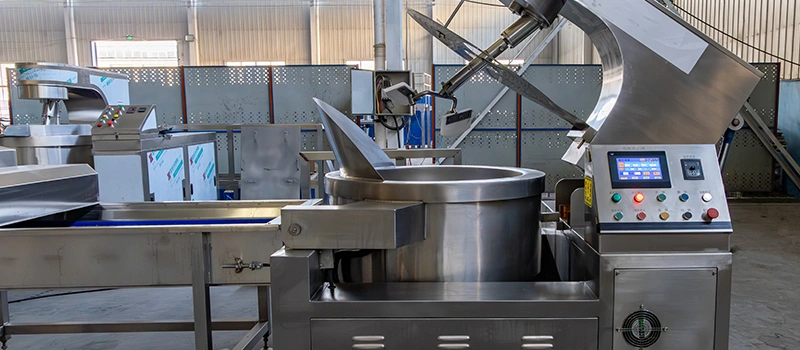
There is no universal "right" capacity — the ideal output depends on the operation's current production volume and 12-to-24-month growth targets. Undersizing leads to bottlenecks; oversizing ties up capital unnecessarily. The following breakdown provides a practical starting point:
| Business Type | Recommended Capacity | Typical Configuration |
|---|---|---|
| Cinema / Small retail shop / R&D lab | ~50 kg/h | Single industrial popcorn machine, manual or semi-auto |
| Regional snack factory / Supermarket supplier | 200–500 kg/h | Semi-automatic popcorn production line |
| Large-scale snack manufacturer / Export producer | 500–1,000 kg/h | Fully automated continuous popcorn production line |
For factories targeting 200 kg/h or more, a continuous popcorn production line — integrating popping, cooling, seasoning, sifting, and packaging into one automated flow — is typically more cost-efficient than running multiple individual machines in parallel. A single operator can manage an entire automated line, compared to the three to five workers typically needed for equivalent output using standalone units.
Any food processing machine is only as trustworthy as the materials it is built from. For industrial popcorn making machines, the baseline standard for all food-contact surfaces is SUS304 stainless steel (equivalent to AISI 304 in the United States). This grade of stainless steel is specified by food equipment sanitation bodies because it is non-toxic, non-absorbent, and resistant to the corrosion caused by sugar syrups, oils, and cleaning agents used in daily sanitation. (USDA Equipment Sanitation Guidelines)
All cooking pots, mixing drums, and conveyor surfaces should be SUS304 or better
Welds should be smooth and crevice-free to prevent bacterial accumulation
Avoid machines with painted interior surfaces or unspecified alloy grades on food-contact parts
Ask for material certification documentation from the manufacturer
Confirm compliance with local food safety regulations (e.g., FDA food equipment standards in the U.S., CE in Europe)
Machines built to these standards also support HACCP (Hazard Analysis and Critical Control Point) compliance — a systematic approach to identifying and preventing food safety risks throughout the production process. (FDA HACCP Guidelines)
For plain salted or butter-flavored popcorn, a basic tumbler or drum mixer may be sufficient. But for caramel, cheese, chocolate, and other coated varieties — which command significantly higher retail prices — the seasoning system is where quality is made or broken.
A standard drum mixer rotates the batch around a single axis. This creates a consistent rolling motion, but kernels in the center of the batch often receive far less coating than those on the outer edge. The result: clumps of over-coated kernels alongside bare, uncoated ones — a consistency problem that is immediately visible to end consumers.
A planetary seasoning system moves the agitator simultaneously around the bowl's central axis and on its own axis — mirroring the same motion principle used in industrial planetary mixers. This multi-directional movement ensures full, uniform coating on every kernel. When combined with an automated syrup and oil dosing system, planetary seasoning eliminates the batch-to-batch inconsistency that is the most common complaint about lower-specification industrial popcorn machines.
The degree of automation in a popcorn production line is one of the most significant long-term cost drivers — not in terms of purchase price, but in ongoing labor and quality control costs. Modern industrial popcorn making machines increasingly incorporate PLC (Programmable Logic Controller) systems that enable:
Pre-programmed batch recipes are executed automatically — no skilled operator needed for each step.
Touchscreen displays show live temperature, batch progress, and cycle count for complete transparency.
Automatic error detection alerts operators to issues (overheating, motor faults) before they cause product loss.
Multiple flavor profiles can be stored and recalled instantly, reducing changeover time between production runs.
For operations producing at 200 kg/h or above, a fully automated popcorn production line — where one operator manages the entire process from popping through to packaging — typically recovers its cost premium over manual machines within 12 to 18 months of operation, purely through labor savings and reduced waste.
An aspect that is frequently overlooked during equipment selection is the cooling stage. After popping and coating, popcorn needs to be cooled quickly and uniformly for two reasons: first, to set the coating (particularly important for caramel, which remains tacky and prone to clumping until it drops below approximately 35°C); second, to lock in crispness before the product moves to sifting or packaging.
Industrial-grade cooling conveyors use forced-air circulation systems — typically a combination of a stainless-steel mesh belt and industrial fans — to bring product temperature down rapidly and evenly. A machine that skips this stage or relies on ambient cooling will produce clumped, soft, or mis-shapen product, especially in warm or humid factory environments. When evaluating a popcorn production line, cooling conveyor length and airflow capacity should be proportional to the popping output rate.
Purchase price is a one-time consideration; energy cost is ongoing. Over a five-year operational period, the electricity or gas expenditure of an industrial popcorn machine can easily exceed its purchase cost. Key efficiency metrics to request from any manufacturer include:
| Parameter | What to Look For | Why It Matters |
|---|---|---|
| Total installed power (kW) | Matched to output capacity — not oversized | Prevents unnecessary idle power draw |
| Heat-up time to operating temp | Under 5 minutes for induction models | Shorter pre-heat = less wasted energy per shift |
| Thermal insulation of cooking pot | Double-wall or insulated construction preferred | Retains heat between batches, reducing cycle energy |
| Energy recovery / standby mode | Available on advanced PLC models | Reduces consumption during idle periods between batches |
Sugar-based coatings like caramel are notoriously difficult to clean if equipment is not specifically designed for it. In a busy production facility, cleaning time between flavors or at the end of a shift directly impacts productive hours. The most cleanable industrial popcorn making machines share several design characteristics:
Tool-free disassembly of the cooking pot and seasoning drum
Smooth interior welds with no blind corners where caramel can collect and harden
Food-grade seals and gaskets that withstand repeated washing without cracking
Tilting or hinged pot design for direct access and drainage
Clearly labelled lubrication points using food-safe lubricants (compliant with FDA 21 CFR 178.3570)
Machines that score poorly on cleanability may look attractive on paper but generate significant hidden costs through extended downtime, increased cleaning-chemical consumption, and the ongoing hygiene risk of residue buildup — particularly critical for products like caramel popcorn where burnt sugar residue can transfer bitter flavors to subsequent batches.
A well-featured machine from an unreliable manufacturer can become a production liability. Before committing to any industrial popcorn machine purchase, buyers should verify the following non-negotiable criteria:
Required for machines sold or operated in European markets. Confirms electrical and mechanical safety compliance.
Indicates the manufacturer operates a documented quality management system — reducing the risk of inconsistent build quality.
Ask for typical lead times on wear parts (belts, seals, heating elements). Long lead times from overseas suppliers can shut down production for weeks.
Reputable manufacturers provide installation support, operator manuals, and video training — reducing startup failures and operator error.
For buyers sourcing from overseas manufacturers, it is also worth confirming whether the supplier provides on-site installation commissioning or remote video guidance, and what the warranty period covers — specifically whether it includes electrical components, heating elements, and the PLC control system.
One of the most overlooked purchasing criteria is whether a machine or line can be expanded as the business grows. The most future-proof popcorn production line configurations are built on a modular architecture — where individual stations (popper, cooler, seasoning drum, sifter, packaging feeder) can be added or upgraded independently without replacing the entire line.
A snack company that starts with a single 50 kg/h industrial popcorn machine and later wins a supermarket supply contract will face a very different upgrade path depending on whether its original equipment was designed with expansion in mind. Buyers should ask manufacturers directly: "Can additional popping units be integrated into this line later?" and "Is the control system scalable to manage additional stations?"
Tell XINYE's engineering team your target daily output, flavors, and facility dimensions — and receive a customized equipment recommendation plus factory-direct quote within 24 hours.
Request a Free Custom QuoteNo commitment required · Response within 24 hours · Factory-direct pricing
Use the table below as a quick reference when comparing any industrial popcorn making machine or popcorn production line specification sheet:
| Feature Category | Minimum Standard | Best-in-Class Specification |
|---|---|---|
| Heating method | Gas with manual temperature control | Electromagnetic induction, ±1°C precision |
| Popping rate | ≥90% | ≥98% with uniform 180–220°C heating |
| Food-contact material | SUS304 stainless steel | SUS304 + mirror-polished welds, no crevices |
| Seasoning system | Drum mixer | Planetary seasoning with auto dosing |
| Automation | Semi-automatic with timer control | Full PLC + touchscreen, recipe memory, fault alerts |
| Cooling | Ambient / passive cooling | Forced-air conveyor cooling system |
| Capacity range | 50 kg/h (single unit) | Up to 1,000 kg/h (full automated line) |
| Certifications | Basic manufacturer declaration | CE + ISO 9001 + third-party material certification |
| After-sales support | Manual + email support | On-site commissioning + video training + spare parts inventory |
Choosing the right industrial popcorn machine comes down to matching the right combination of heating technology, output capacity, food safety construction, coating system, and automation level to the specific needs of the business — both today and over the next three to five years. Operators who focus only on sticker price often find themselves paying far more through waste, downtime, and quality inconsistencies over the machine's operational life.
The global popcorn snack market continues to expand — driven by cinema recovery, e-commerce gourmet channels, and growing demand for premium coated varieties in Asia-Pacific and beyond. Producers who invest in properly specified equipment are best positioned to capture this growth with consistent quality and scalable output.
For businesses searching for a reliable industrial popcorn machine manufacturer that combines engineering precision with comprehensive after-sales support, XINYE Machinery offers a full range of solutions — from single industrial popcorn making machines at 50 kg/h to fully automated popcorn production lines reaching 1,000 kg/h — all built with SUS304 construction, electromagnetic induction heating options, and planetary seasoning technology. Explore XINYE's industrial popcorn machine range and connect with their engineering team for a tailored production plan.
For small operations such as cinemas or retail shops, around 50 kg/h is typically sufficient. Mid-size snack factories generally require 200–500 kg/h, while large-scale popcorn production lines can reach 1,000 kg/h or more.
Gas heating has a lower upfront cost and suits basic flavors like salted or buttered popcorn. Electromagnetic heating offers faster heat-up (around 4 minutes per batch), ±1°C precision, and no open flame — making it the preferred choice for caramel and chocolate-coated varieties.
All surfaces in contact with food should be SUS304 (AISI 304) stainless steel — corrosion-resistant, easy to clean, and compliant with international food equipment sanitation standards.
Unlike a standard drum mixer, a planetary system moves the agitator on two axes simultaneously — ensuring every kernel is fully coated with syrup, oil, or powder with no clumping or bare spots.
Not necessarily. Single industrial popcorn machines suit cinemas, small shops, and R&D testing. A full automated line becomes cost-effective when daily output targets exceed 200 kg.
Buyers should look for CE certification, ISO 9001 quality management certification, and food-grade material compliance documentation. Some manufacturers also provide SGS or third-party inspection reports.

 Phone:0086-15908033216
 E-mail: olivia.xinye@gmail.com
 Whatsapp/WeChat: +86 15169588915
 ADD: No.78, Jianqiao Road, Shunwang Sub-district, Zhucheng City, Weifang City, Shandong Province
Customer Message
Designed by Zhonghuan InternetCopyRight © 2026 ZHUCHENG XINYE MACHINERY CO., LTD. All rights reserved All tags Sitemap