



News Categories

For any food manufacturer cooking sauces, pastes, fillings, or confectionery at scale, one question comes up repeatedly: why do batches burn on the bottom, and why does the texture vary from one run to the next? The answer almost always points back to the mixing and heating equipment. This guide explains how a planetary cooking mixer solves both problems — and why it has become the production standard for industrial sauce, paste, and filling manufacturers worldwide.
A planetary cooking mixer combines simultaneous rotation and revolution to eliminate all mixing dead spots and prevent ingredient burn-on.
Four heating options — gas, steam, induction, and thermal oil — allow the same machine design to suit very different recipes and factory setups.
Industrial models range from 100L to 500L, with a practical working load of 60–80% of total volume per batch.
Automated discharge, programmable controls, and hydraulic tilting significantly reduce labour requirements per production shift.
The one-piece stamped SUS304 stainless steel kettle body ensures the scraper makes 100% contact with the surface, delivering the "zero-burn" standard.
Common applications include chili sauce, curry paste, hotpot base, jam, caramel, miso, and confectionery fillings.
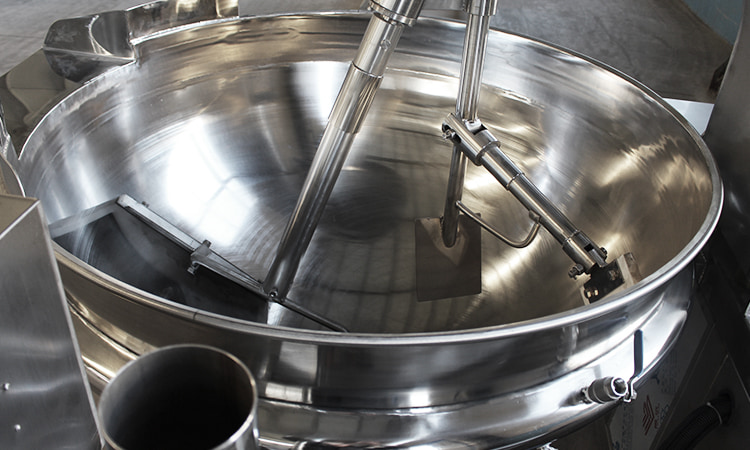
A planetary cooking mixer is an industrial cooking machine that combines a heated kettle — usually jacketed or with a direct heat source — with a powered agitation system that mimics the motion of planets in a solar system. The mixing tool rotates on its own axis while simultaneously revolving around the centre of the kettle. This dual-motion pattern means the agitator covers every point inside the bowl continuously, leaving no corners, edges, or bottom areas unprocessed.
This design distinguishes the machine from a conventional cooking kettle or a simple paddle mixer. Standard kettles heat food but rely on occasional manual stirring or fixed-position agitators that create "dead zones" — areas where ingredients sit still long enough to scorch. This equipment eliminates dead zones by design. For a technical explanation of how the planetary agitation mechanism works in industrial settings, this overview of industrial planetary mixer principles provides useful background.
The result is a machine capable of cooking large batches of sauces, pastes, fillings, and confectionery products with consistent texture, even heat distribution, and no burn-on waste — batch after batch.
Before examining how the machine works in detail, it is useful to understand what problem it actually solves for food manufacturers.
When cooking viscous products like chili sauce, curry paste, jam, or caramel at scale, two problems appear consistently:
High-viscosity ingredients — especially those containing sugar, starch, or chili particles — settle and stick to the heated bottom surface if they are not constantly moved. In a conventional hand-welded kettle, the inner surface is uneven, and even a close-fitting paddle cannot maintain continuous contact across the entire bottom. As a result, a thin layer of product adheres, overheats, and scorches. This damages not only the flavour of the entire batch but also means wasted raw material and time-consuming cleaning between runs.
Traditional vertical or fixed-arm agitators move product in predictable circular paths, leaving zones near the walls and edges unmixed. In sauce and paste production, this produces batches where oil and solid particles separate unevenly, spice distribution is inconsistent, and the emulsion breaks. For manufacturers supplying retail or food service customers, inconsistency at this stage translates directly into customer complaints and brand damage.
A properly engineered machine of this type addresses both problems simultaneously through its agitation geometry and kettle construction.
The mechanical principle behind a planetary cooking mixer is elegant in its simplicity. The agitator shaft is set at an inclined angle relative to the kettle centre. As the drive system activates, this shaft both revolves around the kettle's central axis and rotates on its own axis at the same time — at a non-integer transmission ratio between the two motions.
The non-integer ratio is critical. If the revolution speed and the self-rotation speed shared a common factor, the agitator would follow repeated identical paths, missing the same spots every cycle. By using a non-integer ratio, the paths never exactly repeat, ensuring every point on the kettle surface is swept continuously and uniformly. This is the engineering basis of the "zero dead spot" standard that high-quality machines achieve.
Attached to the agitator is a food-grade PTFE or ethylene scraper shaped to match the exact curvature of the kettle interior. As the agitator moves, the scraper maintains constant pressure against the bottom and sides, lifting any adhering product back into the mixing flow before it can burn. For a broader look at industrial mixer working principles, this technical guide on industrial planetary mixers covers the mechanics in depth.
The scraper can only do its job if the kettle surface it runs against is perfectly smooth and consistently shaped. This is why kettle body construction is just as important as the agitation system itself.
Many lower-cost cooking machines use a hand-welded kettle body. Welding introduces surface irregularities — raised seams, slight warping, uneven curves — that prevent a scraper from maintaining flush contact. Any gap between scraper and surface is a hot spot where product can accumulate and burn.
A quality machine in this category uses a one-piece hydraulic stamped kettle body. The entire interior bowl is formed in a single stamping operation from heavy-gauge SUS304 food-grade stainless steel. This produces a perfectly smooth, consistently curved interior surface with no weld seams. The scraper fits it exactly, delivering the "zero-burn" standard: every portion of product is continuously lifted and mixed, with nowhere to adhere and overheat.
SUS304 stainless steel is the established material standard for food-contact equipment surfaces because of its corrosion resistance, non-reactivity with food acids and oils, and cleanability — a requirement reinforced by food equipment hygiene frameworks including those maintained by the U.S. Food and Drug Administration under the Food Safety Modernization Act.
One of the most important decisions when selecting industrial cooking equipment is the heating source. Different recipes require fundamentally different heat profiles, and the energy infrastructure of each factory differs. Four heating configurations cover the full range of industrial food production needs.
High-intensity open flame creates authentic "wok hei" aroma
LPG, natural gas, or propane compatible
Gas consumption: 4–12 kg/hr LPG depending on volume
Lower equipment cost; higher raw energy cost
Gentle, stable temperature prevents scorching of delicate products
Working pressure: 0.3 MPa
Ideal where temperature precision is critical
Common in pharmaceutical and high-hygiene environments
No open flame; clean and safe for enclosed facilities
Heating power: 20–50 kW depending on volume
Up to 30% lower energy cost than equivalent gas setups
Rapid heat-up and precise control
Maintains very precise high temperatures without hot spots
Available with gas or electric heating of the oil circuit
Essential for sugar-based products prone to crystallisation
Consistent wall temperature prevents local over-heating
The table below summarises key published specifications across the standard capacity range, using the induction heating configuration as a representative reference for a planetary cooking mixer:
| Capacity | Mixing Motor | Heating Power (Induction) | Mixing Speed | Kettle Diameter | Max Load |
|---|---|---|---|---|---|
| 100 L | 1.5 kW | 20 kW | 0–33 RPM | φ 800 mm | 60 kg |
| 200 L | 1.5 kW | 20 kW | 0–33 RPM | φ 900 mm | 120 kg |
| 300 L | 1.5 kW | 30 kW | 0–33 RPM | φ 1000 mm | 170 kg |
| 400 L | 2.2 kW | 40 kW | 0–33 RPM | φ 1100 mm | 230 kg |
| 500 L | 2.2 kW | 50 kW | 0–33 RPM | φ 1200 mm | 280 kg |
Note: Useful working load is typically 60–80% of stated volume capacity. Gas, steam, and thermal oil configurations have different fuel and electrical consumption profiles; consult the manufacturer for a direct operating cost comparison based on local energy prices.
The efficiency gains are practical and measurable. Here are the six most significant improvements food manufacturers typically see after switching from conventional cooking equipment to a planetary cooking mixer.
In conventional kettles, scorched product on the bottom often contaminates the entire batch with burnt flavour, requiring it to be discarded. With the continuous scraping action of a properly designed cooking mixer, burn-on is structurally prevented. There is no scorched layer to contaminate the batch. Material yield per cook cycle improves significantly, and the cost of discarded batches is eliminated.
The non-integer planetary motion ensures that every part of the batch — from the centre to the edges to the very bottom — experiences the same mixing intensity and temperature exposure. This produces consistent viscosity, flavour, emulsion stability, and particle distribution across every batch, which is essential for manufacturers supplying retail chains or food service customers with defined product specifications.
A fully equipped machine with programmable controls, variable frequency speed regulation, and hydraulic automatic tilting for discharge requires minimal operator intervention during a cook cycle. The operator sets the parameters, the machine runs the cycle, and hydraulic tilting empties the kettle without manual scooping or tipping. In operations that previously required constant manual stirring, a single operator can now supervise multiple machines simultaneously.
Industry data consistently shows that food production automation reduces direct labour requirements. According to market analysis, food processing automation adoption reduced average labour costs by approximately 16% in 2026, with productivity gains widely reported across cooking and processing operations.
The smooth, crevice-free one-piece stainless steel interior is significantly faster to clean than a welded kettle. The hydraulic tilting mechanism allows rapid and complete discharge without residual product pooling at the base. These factors reduce dead time between successive production batches, increasing the number of cook cycles achievable per shift without increasing staff headcount.
A single machine in this category can handle products ranging from thin-bodied condiment sauces to extremely thick confectionery pastes, because the variable frequency drive allows mixing speed to be adjusted steplessly from near-zero to full speed. The same unit that slow-cooks a delicate caramel can run at higher speed to emulsify a chili oil base. This multi-product flexibility allows manufacturers to expand their recipe range without investing in additional dedicated equipment.
Because product does not burn onto the kettle surface, cleaning times are shorter and there is no need to run extra cycles to compensate for lost batches. The induction heating option, in particular, delivers energy directly to the kettle base without heat loss to the surrounding environment, reducing energy consumption per kilogram of cooked product compared to gas-fired alternatives. The global food processing equipment market — valued at approximately USD 48.1 billion in 2024 and projected to grow at a 4.8% CAGR through 2034 — reflects how strongly manufacturers are investing in automated, energy-efficient cooking technology. More detail is available from Global Market Insights' food processing equipment market report.
XINYE Machinery specialises in industrial cooking mixers with one-piece stamped SUS304 kettle bodies, tilted planetary agitation, and four heating options — built for sauces, pastes, fillings, and confectionery at scale. Factory-direct pricing and customised engineering support available.
Request a Free Quote from XINYE →Understanding which food categories benefit most from this technology helps manufacturers evaluate whether the investment is justified for their specific production needs.
| Product Category | Why This Equipment Excels | Recommended Heating |
|---|---|---|
| Chili sauce, sambal, XO sauce | Chili particles burn easily; continuous scraping prevents this while high heat develops flavour | Gas / Induction |
| Curry paste, hotpot base | Dense spice mixtures need thorough emulsification; planetary motion integrates oils and solids evenly | Gas / Steam |
| Jam, fruit preserve | High sugar content risks rapid caramelisation; scraper prevents this while water evaporates safely | Steam / Induction |
| Caramel, toffee, candy mass | Crystallisation is prevented by precise wall temperature uniformity; no hot spots | Thermal Oil |
| Miso, hummus, nut paste | High-viscosity pastes require consistent torque and full-coverage agitation to homogenise | Steam |
| Bean paste, lotus seed filling | Delicate texture requires gentle but thorough mixing; precise scraping retains particle integrity | Steam / Induction |
| Peanut butter, sesame paste | Oil and solid separation is controlled by continuous agitation during the cook-and-mix cycle | Induction / Gas |
Selecting the correct industrial cooking equipment involves matching capacity, heating configuration, and automation level to the specific production requirements of each facility. The following questions provide a practical framework.
Multiply the target daily output volume by the expected number of cook cycles per shift (allowing for loading, cooking, discharge, and cleaning time per cycle). This figure determines the minimum kettle capacity needed. A 300L machine cooking 170 kg per batch with a 45-minute cycle can realistically complete 8–10 batches in a standard production shift.
High-viscosity products (thick pastes, dense curry, confectionery masses) require higher torque and more aggressive scraper pressure. Products with significant sugar content need precisely controlled wall temperature to prevent crystallisation or caramelisation — pointing toward thermal oil or steam heating rather than direct gas flame.
Induction heating requires adequate electrical capacity (20–50 kW per machine depending on size). Gas heating requires gas supply lines and ventilation. Steam heating requires a boiler or steam supply. Thermal oil heating requires either gas or electric oil-heating infrastructure. The most technically suitable heating option is only viable if the factory can support it.
If the production line cooks multiple different products on the same machine — common in smaller factories — changeover speed and cleanability become critical. Smooth one-piece interior construction, hydraulic tilting, and programmable controls minimise changeover time between different product runs significantly.
| Parameter | What to Look For | Why It Matters |
|---|---|---|
| Kettle body construction | One-piece hydraulic stamped, not hand-welded | Determines whether the scraper can achieve 100% surface contact |
| Material | SUS304 stainless steel, food-grade inner surface | Hygiene compliance and corrosion resistance |
| Agitator transmission ratio | Non-integer ratio between revolution and self-rotation | Ensures zero dead spots in the mixing path |
| Heating source | Matched to product type and factory energy supply | Affects flavour, energy cost, and temperature control |
| Variable speed control | Frequency inverter (VFD), 0–33 RPM stepless | Allows the same machine to handle different product viscosities |
| Discharge mechanism | Hydraulic automatic tilting | Enables rapid, complete discharge without manual handling |
| Control system | Programmable logic controller (PLC) with touchscreen HMI | Enables repeatable recipes and reduces operator skill dependency |
| Scraper material | Food-grade PTFE or ethylene; confirmed fit to kettle curve | Prevents burn-on and ensures fast cleaning between batches |
Summary: A planetary cooking mixer improves food production efficiency by solving the two core problems that limit conventional cooking kettles: burn-on waste and inconsistent mixing. Its non-integer planetary agitation, precision-fitted scraper, and one-piece stamped kettle body ensure that every batch is cooked evenly, discharged cleanly, and ready to meet consistent product specifications — batch after batch. Combined with programmable controls and a choice of four heating sources, it gives food manufacturers the flexibility, reliability, and output consistency needed to scale production without proportionally scaling labour costs.
XINYE Machinery manufactures industrial planetary cooking mixers purpose-built for sauce, paste, filling, and confectionery production — with four heating configurations and capacities from 100L to 500L. If the production goal is zero burn-on, consistent quality, and lower labour cost per batch, XINYE is the manufacturer to contact.
Send an Inquiry to XINYE →
 Phone:0086-15908033216
 E-mail: olivia.xinye@gmail.com
 Whatsapp/WeChat: +86 15169588915
 ADD: No.78, Jianqiao Road, Shunwang Sub-district, Zhucheng City, Weifang City, Shandong Province
Customer Message
Designed by Zhonghuan InternetCopyRight © 2026 ZHUCHENG XINYE MACHINERY CO., LTD. All rights reserved All tags Sitemap