





News Categories

Jam is one of the world's oldest ways of preserving fruit, and commercial jam production has grown from open pots into a precise industrial process. At the center of that process is the industrial jam cooking machine — equipment that heats, mixes, and concentrates fruit with sugar, pectin, and acid into a consistent, shelf-stable product. This guide explains how these machines work, why the cooking method matters, what components and specifications to look at, and how to choose a machine that fits a real production line.
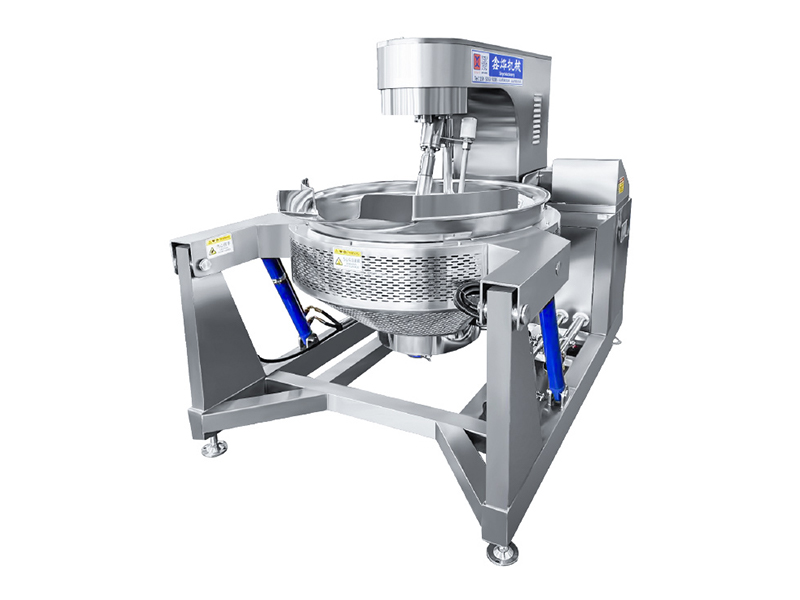
An industrial jam cooking machine combines a food-grade vessel, heating, and mixing to cook and concentrate fruit into jam in controlled batches.
Cooking is a concentration step: water is evaporated until the product reaches its target soluble-solids content, commonly about 65–68 °Brix for commercial jams.
Cooking temperature changes the product: open boiling at 100 °C and above is faster but can darken color and weaken fresh flavor, while vacuum cooking at about 60–80 °C protects both.
Mixing and scraping matter: sugar-based products scorch easily against heated surfaces, so the agitator design directly affects quality and yield.
Capacity, heating type, vacuum capability, and cleaning access should be matched to the recipes and volumes a plant actually runs.
Choosing a reliable manufacturer affects product consistency, food safety compliance, and long-term running costs.
An industrial jam cooking machine is food processing equipment built to cook and concentrate fruit mixtures into jam, marmalade, preserves, or fruit-based fillings. It replaces the open kettle and manual stirring of a small workshop with a controlled system that heats the product evenly, mixes it continuously, evaporates excess water, and discharges the finished batch for filling and sealing.
The machine has to do several jobs at once: bring the fruit–sugar mixture to the right temperature, keep it moving so nothing burns, remove enough water to reach the target concentration, and — in vacuum models — do all of this below the temperature at which fruit color and flavor start to degrade. Depending on the design, the same machine can also handle fruit purees, bean pastes, and other high-viscosity food products.

The cooking step sits inside a simple process chain. Understanding the chain helps buyers see what the equipment must do.
Fruit preparation: fruit is washed, sorted, peeled or stoned, and crushed or pulped.
Formulation: fruit is mixed with sugar, pectin, and acid (often citric acid or lemon juice) according to the recipe.
Cooking and concentration: the mixture is heated so water evaporates and the soluble-solids content rises toward the target level.
Deaeration (optional): air is removed, often under vacuum, to improve color and reduce foaming problems during filling.
Filling and sealing: the hot jam is filled into jars or containers and sealed.
Pasteurization and cooling: filled products are heat-treated and cooled to ensure shelf stability.
Jam sets because of a delicate balance. Pectin, a natural gelling substance in fruit, forms a gel when three conditions are met: enough sugar (roughly 60% or more of soluble solids), the right acidity (pH usually around 3.0–3.5), and sufficient heating. That is why a jam cooking machine is not just a heater — it must evaporate water precisely and mix thoroughly so that sugar, pectin, and acid stay evenly distributed.
Batch cooking is preferred for jam for a practical reason: gelation is sensitive. The operator monitors temperature, Brix, and sometimes pH during the run, and the batch is discharged the moment it reaches the target. Continuous systems exist for very large volumes, but they are harder to use for recipes with whole or large fruit pieces.
Finished-product standards also matter to equipment buyers. In the United States, jams, jellies, and preserves are defined by federal standards of identity for fruit jellies, preserves, and jams, which set minimum soluble-solids levels — fruit jelly, for example, must contain at least 65% soluble solids. International guidance comes from the Codex Alimentarius standards for processed fruit products, while university-based food preservation programs publish practical background on jam and jelly making.

The single biggest choice in jam cooking is whether to boil the product at atmospheric pressure or under vacuum. The two methods differ in temperature, and temperature decides how much of the fruit survives the process.
| Factor | Open Kettle Cooking | Vacuum Cooking |
|---|---|---|
| Boiling temperature | About 100 °C and above | About 60–80 °C under vacuum |
| Color and flavor | Color can darken; fresh aroma may be lost | Natural color and aroma are largely retained |
| Heat sensitivity | Higher oxidation and caramelization risk | Low; gentle concentration |
| Equipment complexity | Simpler, lower cost | Needs vacuum system and condenser; higher cost |
| Typical use | Standard jams, cost-sensitive production | Premium jams and heat-sensitive fruit |
Neither method is wrong — the choice depends on the product and the market. For a standard jam sold mainly on price, open cooking is common and economical. For premium jams where bright color and fresh flavor decide the selling price, vacuum cooking is the usual choice. From an engineering point of view, vacuum cooking lowers the boiling point of water, so moisture is removed at a much lower product temperature while the temperature difference with the heating medium stays large — which is what keeps the concentration step efficient. In practice, the right equipment for a line is the one that matches its recipes and quality targets.
Whatever the type, an industrial machine of this kind is built from the same core parts. Each one affects the finished product, and a weakness in any of them shows up in the batch.
| Component | Function | What to Check |
|---|---|---|
| Cooking vessel | Holds and heats the product | Food-grade stainless steel (304 or 316L), smooth welds, no dead zones |
| Heating system | Supplies heat through the jacket | Steam pressure rating, heating area, even heat distribution |
| Agitator | Mixes the product and prevents scorching | Frame/anchor or scraped-surface design, suitable speed range |
| Vacuum system (optional) | Lowers the boiling point and removes air | Vacuum level, condenser capacity, sealing quality |
| Discharge system | Unloads the finished batch | Valve type, no dead spaces, easy to clean |
| Control panel | Manages temperature, vacuum, speed, and time | Automation level, recipe repeatability, alarms |
Machines differ mainly in geometry and in whether they run under vacuum. The four groups below cover most of the market.
| Type | Best For | Strengths | Limitations |
|---|---|---|---|
| Steam-jacketed open kettle | Small to medium batches, standard jams | Low cost, simple operation | Higher oxidation risk; needs attention to avoid scorching |
| Horizontal cooking mixer | High-viscosity products, larger batches | High torque, no dead spots, vacuum option available | Larger footprint, higher price |
| Vacuum cooking machine | Premium jams and heat-sensitive fruit | Low-temperature cooking, color and flavor retention | Higher investment, more complex |
| Continuous cooker | Very large volumes | High throughput | Less flexible for recipes with whole fruit pieces |
For viscous fruit mixtures and larger batches, a horizontal cooking mixer uses a U-shaped vessel and horizontal stirring to generate higher torque, which avoids the dead spots and motor stalling that vertical kettles can experience with heavy products. When premium quality is the goal, the same platform can be built with a vacuum lid so that boiling happens at low temperature.
Buyers comparing machines should look at the specifications below, matched to their actual recipes and volumes rather than to the largest model available.
| Specification | What to Look For | Typical Range / Note |
|---|---|---|
| Capacity | Batch volume that matches production output | Commonly 50–1000 L per batch; larger models for special lines |
| Heating type | Steam, electric, or gas, matched to the site | Steam jacket is common; check the design pressure (e.g., 0.3 MPa) |
| Material | Food-contact grade stainless steel | 304 for general use; 316L for acidic or aggressive products |
| Agitator | Matches viscosity and heating surface | Frame/anchor or scraped surface; horizontal mixers often run 8–25 rpm |
| Vacuum capability | Lowest achievable boiling temperature | Vacuum cooking typically reaches about 60–80 °C |
| Cleaning design | Access to all product-contact surfaces | CIP connections and a fully drainable design are preferred |
| Controls | Repeatability from batch to batch | Temperature, vacuum, and speed control with alarms |
Values are typical industry ranges and reference points; confirm exact figures with the machine manufacturer for a specific model.
A simple check helps buyers size a machine: divide the required daily output by the number of batches the plant wants to run per day, then add a margin for filling losses and cleaning time. A line that needs 2,000 kg of finished jam per day in four batches, for example, should look at equipment with a useful batch capacity comfortably above 500 kg, not exactly at it.
Hygiene and maintenance decide whether the equipment stays reliable over years of use.
Hygiene: clean all product-contact surfaces after every batch. Sugar residues attract microbial growth and darken the next batch's color.
Pressure and vacuum safety: respect the steam pressure limit, keep safety valves in order, and make sure vacuum vessels have proper pressure relief. Operators should be trained before first use.
Routine maintenance: check agitator seals, vacuum pump oil, and heating surfaces; remove scale regularly so heat transfer stays efficient.
Documentation: keep operating and cleaning logs, and follow the food-safety plan (for example HACCP) required by the target market.
For export-oriented plants, food-contact materials and cleaning access are often audited by customers or certification bodies. Machines with smooth welds, removable parts, and CIP connections make these audits considerably easier to pass.
Machines of this kind serve the whole fruit processing industry:
Fruit jams — strawberry, blueberry, apricot, mango, and many others.
Marmalades and citrus preserves.
Fruit-based bakery fillings and dessert bases.
Fruit purees, coulis, and fruit pastes for confectionery.
The same machine can often be reconfigured for different recipes, which is why flexibility is one of the first questions buyers ask. In some regions the same platform also handles related high-viscosity products such as bean paste, making the investment easier to justify.
Buying decisions come down to matching the machine to the production plan. The questions below cover the points that matter most:
Output: expected daily output and batch size, which set the required capacity.
Heating source: what is available on site — steam, electricity, or gas.
Product types: chunky or smooth, high-viscosity or free-flowing.
Quality target: standard jam or premium low-temperature product.
Hygiene requirements: food-contact materials, cleaning access, CIP compatibility.
Support: drawings, manuals, spare parts, and after-sales service.
Buyers evaluating options will meet both horizontal cooking mixers and dedicated vacuum processing lines. A horizontal cooking mixer suits high-viscosity products and larger batches, while a vacuum processing line is chosen when color and aroma must be preserved. Both should be reviewed against the recipes the plant actually runs.
XINYE is an original manufacturer of industrial food processing equipment, supplying horizontal cooking mixers from 300 to 1,000 L with optional vacuum systems for low-temperature jam cooking. The engineering team can configure a standard or vacuum platform for specific recipes and can integrate condenser systems for fruit essence recovery. Buyers can contact XINYE directly for specifications, samples, and quotes.
Send Inquiry — Get a QuoteAn industrial jam cooking machine is, at its core, a controlled way to do something simple: remove water from fruit and sugar without damaging the product. Open cooking remains a practical choice for many standard products, while vacuum cooking earns its higher investment by protecting color, flavor, and nutrients for premium markets. The right machine balances capacity, heating, mixing, hygiene, and cost against the recipes the line actually runs. With a clear specification and a reliable manufacturer, it becomes a stable, repeatable part of the production line rather than a source of surprises.
It heats, mixes, and concentrates fruit with sugar, pectin, and acid into jam. It replaces manual open-kettle cooking with controlled temperature, agitation, and — in vacuum models — low-temperature concentration.
Vacuum cooking lowers the boiling point to about 60–80 °C. This removes water gently and protects the fruit's natural color, aroma, and nutrients, which are damaged by prolonged boiling above 100 °C.
The standard check is soluble solids, measured in degrees Brix with a refractometer. Most commercial jams are finished at about 65–68 °Brix, and some product standards set legal minimums.
Capacity should match daily output and batch cycles. Smaller plants often start with batch kettles of a few hundred liters, while larger lines use horizontal mixers from 300 L upward.
All food-contact surfaces should be food-grade stainless steel. Type 304 is common; 316L is preferred for acidic products because of its better corrosion resistance.
Wholesale and industrial buyers usually purchase directly from manufacturers. It is worth checking the machine against the plant's recipes, asking for documentation and references, and requesting a quote. XINYE supplies horizontal cooking mixers and vacuum cooking solutions and accepts inquiries directly.

 Phone:0086-15908033216
 E-mail: olivia.xinye@gmail.com
 Whatsapp/WeChat: +86 15169588915
 ADD: No.78, Jianqiao Road, Shunwang Sub-district, Zhucheng City, Weifang City, Shandong Province
Customer Message
Designed by Zhonghuan InternetCopyRight © 2026 ZHUCHENG XINYE MACHINERY CO., LTD. All rights reserved All tags Sitemap