



News Categories

For food production managers, central kitchen operators, and sauce manufacturers evaluating large-scale cooking equipment, the choice between a tilt kettle and a steam jacketed kettle is one of the most consequential equipment decisions on the floor. Both are designed to cook large batches of food — but they achieve that goal through fundamentally different mechanisms, and those differences translate directly into product quality, energy costs, infrastructure requirements, and long-term operational outcomes.
The short answer is: neither is universally better. The right choice depends almost entirely on what food is being produced. This guide breaks down how each type of cooking kettle works, where each performs best, and how the introduction of integrated mixing technology has changed the calculus for food manufacturers processing high-viscosity, heat-sensitive products.
Whether a buyer is sourcing their first industrial cooking kettle, expanding an existing production line, or weighing an upgrade to address scorching and quality consistency issues, this comparison provides the technical context needed to make a confident decision.
Tilt kettles (especially induction-heated) offer installation simplicity and faster setup — ideal for high-volume liquid products in new or flexible facilities.
Steam jacketed kettles deliver uniform, gentle indirect heat via a pressurized outer jacket, making them the superior choice for heat-sensitive products like jams, custards, and thick pastes where scorching is a critical risk.
The heating surface area of a jacketed cooking kettle (sides + bottom) is substantially larger than that of a direct-bottom-heated kettle, supporting more even temperature distribution at scale.
The traditional weakness of steam jacketed kettles — the need for manual stirring — is eliminated in modern configurations that integrate planetary mixing systems.
Total cost of ownership, not just purchase price, should drive the selection: infrastructure costs, energy consumption, labor, and product quality outcomes all affect long-term ROI.
A tilt kettle — also called a tilting braising pan or mixer kettle — is a large-capacity cooking vessel mounted on a pivot frame that allows the entire bowl to tilt, typically up to 90°, for easy discharge of cooked product. The tilting mechanism replaces the need for a pump or bottom drain valve and allows a single operator to empty large quantities of hot food safely into containers or transport vessels.
Tilt kettles are available in three primary heating variants:
Gas-fired tilt kettles: Use direct gas burners beneath the cooking vessel. Energy efficiency is typically 40–50%, with open flame and combustion byproducts to manage.
Electric resistance tilt kettles: Use electric heating elements, achieving efficiency of approximately 65–75%, with simpler installation than gas but slower heat-up times than induction.
Electric induction tilt kettles: Use electromagnetic energy to heat the cooking vessel directly, achieving efficiency of approximately 80–90%. This is the most common variant specified in modern kitchen upgrades due to its plug-and-play installation and fast response time.
Most modern tilt kettles include a built-in stirring arm or mixer paddle, programmable digital controls, and capacity options ranging from approximately 75 liters to 750 liters. Many models are wall-mounted or floor-standing with no fixed infrastructure beyond an adequate electrical supply. Industry data on commercial cooking kettles confirms that tilting floor-type models typically range from 20 to 200 gallons (75–750 liters) in capacity.
A steam jacketed kettle — also called a steam cooking kettle, jacketed cooking pot, or steam kettle — is a double-walled industrial cooking vessel in which pressurized steam circulates in the annular space between the inner cooking bowl and the outer jacket. The steam never makes direct contact with the food; instead, it transfers heat through the stainless steel wall of the kettle via conduction. This indirect heating method produces uniquely gentle, enveloping heat that is distributed across both the bottom and sides of the cooking vessel simultaneously.
According to Oklahoma State University's Extension resource on steam basics for food processors, a steam jacket distributes heat over a wide surface area, with condensing steam transferring energy through the vessel wall uniformly. The stagnant layers of product on heat-transfer surfaces — the primary cause of burning and scorching — can be reduced by agitation, especially surface-scraping agitation. This is why the combination of steam jacketing and mechanical scraping delivers the best quality outcomes for heat-sensitive products.
Steam jacketed kettles are available in stationary and tilting configurations, with capacities commonly ranging from 20 liters (tabletop) to over 750 liters (industrial floor models). Operating steam pressures typically range from 3 to 3.5 bar (45–50 PSI), generating uniform kettle surface temperatures between 130°C and 170°C (267–338°F). The most common commercial configuration is the two-thirds jacketed design, which heats the product from both the bottom and the lower sides — dramatically increasing the energy-absorbing surface area compared to direct-bottom-heat methods.
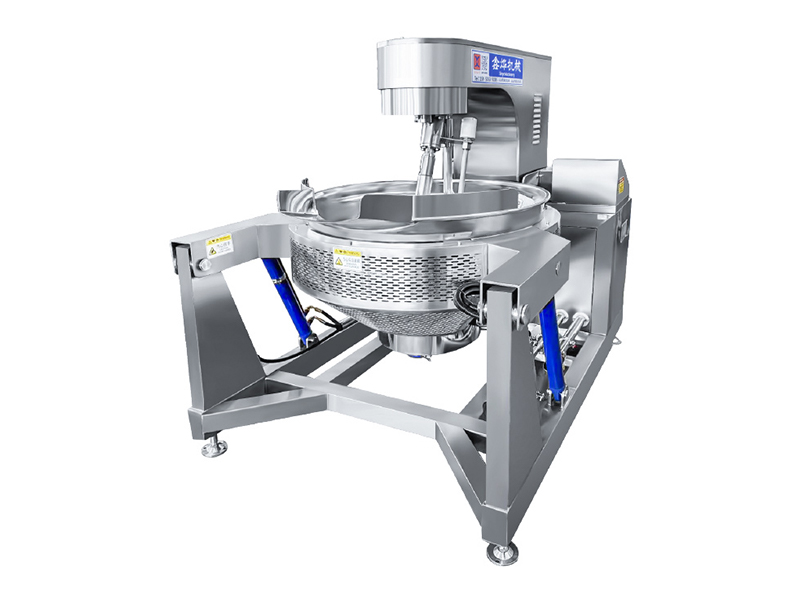
The table below summarizes the core technical differences between the two cooking kettle types across the dimensions most relevant to food production decisions.
| Comparison Factor | Tilt Kettle (Induction/Electric) | Steam Jacketed Kettle |
|---|---|---|
| Heating Method | Direct electromagnetic or resistance heating | Indirect steam via pressurized outer jacket |
| Heat Distribution | From base only (direct) | Bottom + lower sides (jacket surface) |
| Energy Efficiency (heating) | ~80–90% (induction); ~65–75% (resistance) | ~65–75% (self-contained steam) |
| Anti-Scorching Performance | Moderate — hot spots possible at base | Excellent — no hot spots, indirect heat |
| Temperature Adjustment Speed | Near-instant (induction) | Gradual (steam pressure-based) |
| Max Product Temperature | Adjustable, up to ~250°C depending on unit | Typically 130–170°C at standard steam pressures |
| Installation Requirements | Electrical connection only | Steam boiler, piping, condensate return, permits |
| Built-in Mixing | Yes (most modern models) | Optional; varies by model |
| Discharge Method | 90° tilt | Tilt or bottom tangent drain valve |
| Capacity Range (common) | 75–750 L | 20–750+ L |
| Mobility | Relocatable (floor-standing) | Semi-fixed (boiler connection) |
| Best Product Types | Soups, broths, stews, thin sauces, cooked grains | Jams, custards, thick pastes, high-sugar products, confections |
| Food Safety Certifications Available | CE, NSF, UL | CE, ISO9001, HACCP, ASME |
Understanding how each cooking kettle transfers heat to the food is the key to understanding why different food types perform better in each machine.
In a tilt kettle with induction or resistance heating, energy is delivered from the base of the cooking vessel upward into the food. The area directly above the heating element receives the most energy. For thin, fluid products like soups, broths, and clear sauces — which convect freely — this bottom-up heat distribution is effective and consistent. The product's natural circulation carries heat from the base throughout the batch.
The challenge arises with thicker products. When a sauce, paste, or jam doesn't circulate freely, the material directly contacting the hot base receives substantially more heat than the product above it. Without continuous agitation, this thermal gradient produces localized hot spots that cause the classic defects in high-sugar or high-starch products: caramelization, burning, color change, and off-flavors. Constant manual stirring — or a high-efficiency integrated mixer — is required to prevent these outcomes.
A steam jacketed kettle surrounds the product with steam on all jacketed surfaces simultaneously. The heat delivered to any point on the vessel wall is determined by the steam pressure — the same pressure everywhere in the jacket. This means there are no localized hot spots, no temperature gradients across the cooking surface, and no area of the kettle wall that is significantly hotter than any other.
The physical principle at work is the condensation of steam against the inner vessel wall, releasing the steam's latent heat of vaporization. This heat transfer method is extremely efficient at the wall surface — far more so than convective air heating or even direct electrical resistance — while remaining thermally limited by the steam pressure, which acts as a natural temperature ceiling. For a food manufacturer producing high-sugar products, this ceiling is not a limitation: it is the feature that prevents caramelization and browning of sensitive ingredients.
Scorching — the localized burning and caramelization of food product that contacts an overheated surface — is among the most commercially damaging quality defects in food production. It creates off-flavors, discoloration, and waste, and it is particularly problematic for products with high sugar content, high starch concentrations, or protein-rich compositions.
Direct heating creates a higher-temperature zone at the base
High-sugar products (jams, caramel, bean paste) have elevated scorching risk
Integrated mixer partially mitigates this — but at higher speeds, mixer can introduce air into delicate products
Temperature spikes during heating phase can exceed safe thresholds for sensitive sugars
Steam pressure acts as a natural temperature ceiling — no hot spots possible in the jacket
Wall surface temperature is uniform across all jacketed surfaces simultaneously
Ideal for high-sugar products: jams, marmalades, custard creams, peanut cream
With planetary scraping mixing, product never sits stationary against the heated wall
For food producers whose product line includes jams, jellies, fruit concentrates, dairy-based sauces, cream fillings, or confections, the anti-scorching advantage of a steam jacketed kettle is not a minor benefit — it is the single most important quality outcome of the equipment choice. Burned product cannot be salvaged; it represents total batch loss.
The traditional critique of steam jacketed kettles was that they required manual stirring or separate mixing equipment to prevent product from settling and burning against the heated walls. This was a genuine limitation of early stationary steam kettles — and it provided the opening for tilt kettles with integrated mixers to gain market share.
However, modern steam jacketed cooking kettles equipped with integrated planetary mixing systems have closed this gap completely. A planetary mixing system — in which scraper blades revolve around the kettle while simultaneously rotating on their own axis — provides 100% wall contact coverage, continuously moving product away from the heated surface and ensuring full homogenization. This is fundamentally different from a simple center-shaft stirrer, which leaves dead zones near the walls and bottom.
The steam jacket ensures no hot spots — uniform, gentle heat across all jacketed surfaces
The planetary scraper prevents stagnant layers — continuously removes product from the wall surface, eliminating the thermal boundary layer that causes burning
Together: every part of the food product receives the same gentle heat and the same mixing action, producing perfectly homogeneous batches even for thick, sticky, high-sugar products
As Oklahoma State University's food processing research notes, stagnant layers of product on heat-transfer surfaces are among the primary causes of reduced heat transfer efficiency and product burn-on — and surface-scraping agitation is the most effective countermeasure. The integration of this principle with steam jacket heating represents the highest-performance cooking solution for viscous food products.
The financial comparison between tilt kettles and steam jacketed kettles must extend well beyond the equipment purchase price to be meaningful.
A standard electric induction tilt kettle requires only an adequate electrical supply — typically three-phase power appropriate to the unit's rated capacity. No boiler room, no steam piping, no condensate return, and no gas permitting. For new facilities or renovations, this plug-and-play characteristic represents a genuine cost and timeline advantage. Installation is primarily electrical work.
A conventional steam jacketed kettle connected to a facility steam system requires steam supply piping, condensate return lines, steam traps, pressure regulators, and regular boiler maintenance including water treatment, annual inspections, and certification in many jurisdictions. For facilities without existing steam infrastructure, these costs can be substantial.
However, this comparison has nuances that are often overlooked:
Self-contained steam jacketed kettles — which generate steam internally via an electric boiler integrated into the unit — eliminate the need for facility-level steam infrastructure entirely. These models offer the quality advantages of steam jacketing with installation requirements similar to a standard electrical connection.
Facilities with existing steam boiler infrastructure can add steam jacketed kettles at marginal additional infrastructure cost, making the per-unit economics highly favorable.
Long-term maintenance of steam systems is more complex — but also very well-understood, with established maintenance protocols and readily available parts.
| Cost Category | Tilt Kettle | Steam Jacketed Kettle (New Install) | Steam Jacketed Kettle (Existing Steam) |
|---|---|---|---|
| Equipment Purchase | Moderate–High | Moderate–High | Moderate–High |
| Infrastructure Installation | Low (electrical only) | High (if no steam system exists) | Low–Moderate |
| Annual Energy Cost | Lower (induction: ~80–90% efficiency) | Moderate (steam: ~65–75% system efficiency) | Moderate |
| Annual Maintenance | Low (self-contained) | Moderate (steam traps, water treatment) | Moderate |
| Product Scrap Rate (high-sugar products) | Higher (scorching risk) | Very low (gentle, uniform heat) | Very low |
| Labor (with integrated mixing) | Low (integrated mixer) | Low (with planetary mixer) | Low (with planetary mixer) |
The most reliable decision framework is a product-type approach. Different foods have different thermal sensitivities, viscosities, and quality requirements that directly match to the strengths of each cooking kettle type.
| Food Product Type | Tilt Kettle | Steam Jacketed Kettle | Recommended Choice |
|---|---|---|---|
| Fruit jams and marmalades | ✗ High scorching risk (high sugar) | ✓ Gentle heat, no caramelization | Steam Jacketed |
| Bean paste, nut cream, peanut butter | ✗ Sticking and burn risk | ✓ Even heat + planetary mixing | Steam Jacketed + Planetary |
| Custard cream and dairy-based sauces | ◑ Possible with careful control | ✓ Best for delicate proteins and fats | Steam Jacketed |
| Caramel and confections | ✗ Very high burn risk | ✓ Temperature-capped steam heat | Steam Jacketed |
| Savory sauces and condiments (thick) | ◑ Requires careful agitation | ✓ Superior for viscous products | Steam Jacketed |
| Soups, broths, clear stocks | ✓ Efficient for thin liquids | ✓ Also suitable | Either |
| Stews and braised meat dishes | ✓ Good large-batch performance | ✓ Gentle heat preserves texture | Either |
| Tsukudani, Kinpira, traditional Asian dishes | ◑ Possible with monitoring | ✓ Ideal: gentle heat + mixing | Steam Jacketed |
| High-volume thin syrups and beverages | ✓ Fast, efficient | ◑ Possible but less optimized | Tilt Kettle |
Drawing on the technical comparison above, the following framework helps food producers identify the most appropriate cooking kettle configuration for their specific production context.
The primary product is a thin liquid: soup, broth, beverage syrup, or clear sauce that flows freely and convects heat without scorching risk.
The facility is a new build or renovation with no existing steam infrastructure, and installation simplicity is a priority.
The product range is limited and consistent, minimizing the complexity of parameter management.
Labor flexibility and machine repositioning are operational priorities.
Maximum energy efficiency (induction heating at ~80–90%) is a primary cost driver.
The product line includes high-sugar items (jams, marmalades, bean paste, custards, confections) where scorching represents a genuine quality and waste risk.
Batch consistency and product color/flavor preservation are premium quality requirements.
The facility already has steam boiler infrastructure, or a self-contained steam kettle eliminates this concern.
Viscous, thick, or sticky products require both gentle heat and active mixing to prevent wall adhesion.
Products undergo a thermal treatment (pasteurization, sterilization) that benefits from precise, pressure-controlled temperature.
The production process requires an optional cooling step post-cooking — achievable by circulating chilled water through the same jacket.
XINYE (Zhucheng Xinye Machinery Co., Ltd.) specializes in industrial steam jacketed cooking kettles with integrated planetary mixing systems — purpose-built for food manufacturers producing jams, sauces, pastes, and condiments where quality consistency and zero scorching are non-negotiable. Siemens PLC controlled, SUS304 stainless steel throughout, CE/ISO9001/HACCP certified, available in 100L–500L configurations. Factory-direct pricing, full OEM customization, and 24/7 global after-sales support.
Send Inquiry Now View Product Specs →For producers seeking a premium steam jacketed cooking kettle that eliminates the traditional mixing limitation, XINYE's Steam Jacketed Planetary Cooking Mixer integrates both functions into a single, hydraulically tilting unit. The following specifications apply across the standard product range.
| Pot Capacity | Pot Diameter | Motor Power (kW) | Steam Consumption (kg/h) | Revolution (rpm) | Rotation (rpm) | Tilting Mechanism |
|---|---|---|---|---|---|---|
| 100 L | Ø800 mm | 1.5 + 1.5 | 40 | 6.7 – 33 | 14 – 69.3 | Automatic / Hydraulic |
| 200 L | Ø900 mm | 1.5 + 1.5 | 50 | 6.7 – 33 | 14 – 69.3 | Automatic / Hydraulic |
| 300 L | Ø1000 mm | 1.5 + 1.5 | 60 | 6.7 – 33 | 14 – 69.3 | Automatic / Hydraulic |
| 400 L | Ø1100 mm | 1.5 + 2.2 | 70 | 6.7 – 33 | 14 – 69.3 | Automatic / Hydraulic |
| 500 L | Ø1200 mm | 1.5 + 4.0 | 80 | 6.7 – 33 | 14 – 69.3 | Automatic / Hydraulic |
Agitation type: Planetary / Bottom-Scraping | Heating: Steam | Material: SUS304 Stainless Steel | Control: Siemens PLC | Certifications: CE, ISO9001, HACCP
The tilt kettle vs steam jacketed kettle debate does not have a single winner — it has a decision framework. For high-volume production of thin liquids in new or flexible facilities, a modern induction tilt kettle delivers installation simplicity, energy efficiency, and labor savings that are difficult to match. For food manufacturers producing quality-sensitive, high-sugar, or high-viscosity products — where scorching means batch rejection — a steam jacketed kettle with integrated mixing is the technically superior choice, and often the economically superior one when total cost (including product losses) is factored in.
The most significant evolution in the market is the emergence of steam jacketed cooking kettles with integrated planetary mixing systems, which combine the gentle, uniform heat of steam jacketing with the active wall coverage of planetary scraping. For producers of jams, custards, bean pastes, cream sauces, and confections, this combination represents the highest-quality production solution available — one that justifies the infrastructure investment with consistently superior product outcomes, batch after batch.
Food production teams comparing steam jacketed kettle options should evaluate manufacturers who offer both technical depth and customization capability. XINYE's engineering-led approach — with full SUS304 construction, Siemens PLC control, hydraulic tilting, and CE/ISO9001/HACCP certification — represents a benchmark for industrial food equipment quality in this category.

 Phone:0086-15908033216
 E-mail: olivia.xinye@gmail.com
 Whatsapp/WeChat: +86 15169588915
 ADD: No.78, Jianqiao Road, Shunwang Sub-district, Zhucheng City, Weifang City, Shandong Province
Customer Message
Designed by Zhonghuan InternetCopyRight © 2026 ZHUCHENG XINYE MACHINERY CO., LTD. All rights reserved All tags Sitemap