



News Categories

Walk into any large-scale food processing facility — a jam factory, a sauce plant, a central kitchen — and one piece of equipment is almost certainly running: the steam jacketed kettle. It boils, simmers, reduces, and cooks thousands of liters of product at a time, all without burning the bottom or creating hot spots. But how exactly does a steam jacketed kettle transfer heat to the food inside? The answer lies not in a flame or an electric element, but in the physics of steam condensation. This guide breaks down the entire heating mechanism in plain language, from the double-wall jacket structure to pressure control, energy efficiency, and real-world operating parameters.
A steam jacketed kettle heats food indirectly: pressurized steam fills a hollow jacket surrounding the inner bowl, condenses on the inner wall, and releases latent heat through conduction.
Steam carries roughly 2,257 kJ of latent heat per kilogram at 100°C — far more energy per unit than hot water or thermal oil at the same temperature.
The temperature inside a steam jacketed kettle is controlled entirely by steam pressure: higher pressure = higher saturation temperature, adjustable from ~100°C to over 140°C.
Because heating is indirect and covers the entire bowl surface, steam jacketed kettles deliver uniform, gentle heat ideal for heat-sensitive products like jams, custards, and sauces.
Modern steam jacketed kettles commonly use SUS304 food-grade stainless steel for the inner bowl and include safety valves, pressure gauges, and steam traps as standard.
Typical industrial models range from 100 L to 500 L in capacity, with steam consumption between 40 and 80 kg/h depending on size.
A steam jacketed kettle is a large, industrial cooking vessel consisting of two concentric bowls — an inner bowl that holds the food product and an outer shell that creates a sealed hollow space, or "jacket," between the two walls. This jacket is the heart of the heating system. Instead of placing a heat source directly under the bowl (as with a gas burner or electric stove), pressurized steam is injected into the jacket, where it surrounds the entire inner bowl surface and transfers heat evenly through the metal wall.
This design is fundamentally different from direct-heat cooking. In a conventional pot, the flame or element contacts only the bottom, creating a narrow high-temperature zone that easily scorches sugars and thick sauces. In a steam jacketed kettle, the heat source wraps around the bottom and lower sides of the bowl, distributing thermal energy across a much larger surface area. The result is a gentler, more uniform cooking environment — which is why these kettles are the standard choice for jam, jelly, caramel, soup, sauce, and confectionery production worldwide. For reference data on how water's boiling point changes with pressure — a principle central to jacketed kettle operation — this resource on water boiling points and pressure provides useful engineering context.
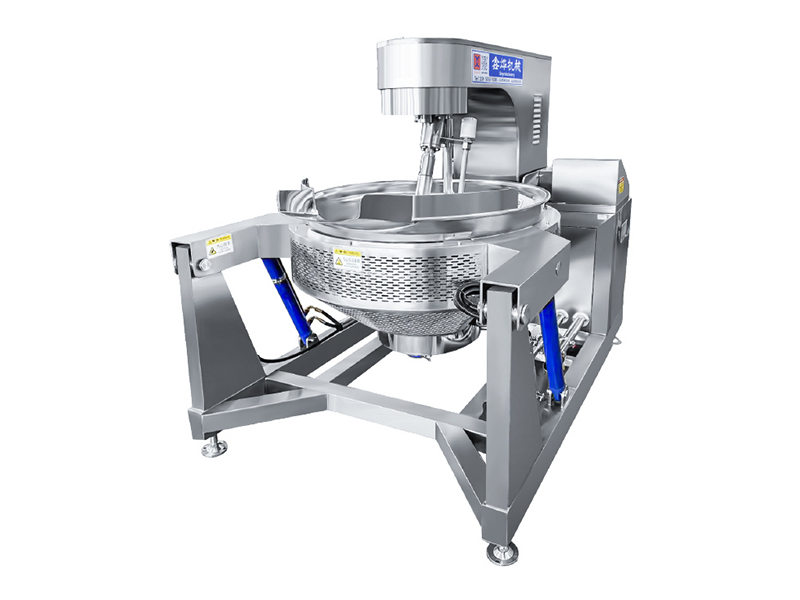
The heating mechanism of a steam jacketed kettle can be understood in three sequential physical stages: steam injection, condensation, and conduction. None of these stages requires the steam to touch the food — the entire process is indirect, which is critical for food safety and product quality.
Saturated steam, generated by an external boiler or steam generator, is piped into the jacket through an inlet valve. The steam enters at a controlled pressure — typically between 0 and 3 bar(g) for food-grade kettles — and rapidly fills the entire annular space between the inner and outer bowls. Because steam is a gas, it conforms to the shape of the jacket and makes contact with every part of the inner bowl's outer surface simultaneously.
This is the step that makes steam heating so efficient. When the hot steam contacts the relatively cooler outer wall of the inner bowl, it immediately condenses from gas back into liquid water. During this phase change, the steam releases its latent heat of vaporization — approximately 2,257 kJ per kilogram at atmospheric pressure. This is an enormous amount of energy: to put it in perspective, heating the same kilogram of liquid water from 0°C to 100°C requires only about 419 kJ. The latent heat released during condensation is more than five times that amount, and it is delivered directly to the bowl wall at a constant temperature.
Because condensation occurs at the saturation temperature corresponding to the steam pressure, the entire inner bowl wall is heated to a uniform, predictable temperature. There are no hot spots or cold zones — the physics of phase change guarantees an even thermal profile. For a deeper explanation of steam thermophysical properties and condensation behavior, this authoritative reference on fluid thermophysical properties from the U.S. National Institute of Standards and Technology is an excellent resource.
The heat released by condensing steam travels through the inner bowl wall — typically 3 to 5 mm of SUS304 stainless steel — by conduction. Stainless steel is not the most thermally conductive metal (its thermal conductivity is roughly 16 W/m·K), but the large surface area of the bowl more than compensates, ensuring efficient heat transfer to the product inside. The condensed water (condensate) drains to the bottom of the jacket and is removed through a steam trap, which allows liquid water to exit while preventing live steam from escaping. This continuous cycle — steam in, condensation, heat transfer, condensate out — maintains a steady heating rate for as long as the kettle operates.
Understanding the individual stages is helpful, but seeing the complete operating sequence of a steam jacketed kettle makes the process clearer. Below is the typical cycle from startup to shutdown:
Pre-heat the jacket: The operator opens the steam inlet valve slightly, allowing low-pressure steam to enter the jacket. Air inside the jacket is vented through an air vent or vacuum breaker. This step prevents air pockets that would insulate the bowl wall and reduce heating efficiency.
Raise to operating pressure: Once air is purged, the steam valve is opened further to reach the target pressure. A pressure gauge on the jacket displays the current pressure, and a safety valve protects against over-pressurization.
Load the product: With the bowl at operating temperature, raw ingredients are loaded. Many modern kettles feature a planetary mixing arm that continuously scrapes the bowl walls, ensuring even heat distribution and preventing burning — especially important for high-sugar or high-viscosity products.
Cook at controlled temperature: The operator adjusts steam pressure to maintain the desired product temperature. Because pressure and temperature are directly linked (see table below), precise pressure control means precise temperature control.
Condensate removal: Throughout cooking, the steam trap continuously removes condensed water from the jacket. A blocked or malfunctioning steam trap causes condensate to accumulate, reducing heat transfer efficiency and potentially causing water hammer.
Shutdown and discharge: When cooking is complete, the steam supply is closed, and residual steam is vented. Many industrial models feature a hydraulic tilting mechanism that tilts the bowl up to 90° for fast, clean discharge.
A steam jacketed kettle relies on several interconnected components to deliver safe, efficient, and consistent heating. Each plays a specific role, and a failure in any one can disrupt the entire process.
The jacket is the sealed cavity between the inner bowl and outer shell. It is designed to withstand the maximum operating steam pressure (typically up to 3 bar(g) for food kettles) and is constructed to ASME or equivalent pressure vessel standards in many regions. The jacket must be completely airtight — any leak reduces pressure, wastes steam, and creates a safety hazard.
The inlet valve controls the flow of steam into the jacket. On basic models, this is a manual globe valve; on advanced units, a pneumatically or electrically actuated control valve modulates steam flow automatically based on temperature sensor feedback. A pressure regulator downstream of the valve ensures that even if the boiler supply pressure fluctuates, the jacket pressure remains stable.
Every steam jacketed kettle must have a pressure gauge so the operator can verify jacket pressure at a glance. Equally critical is the safety relief valve, which automatically opens if pressure exceeds the design limit, preventing catastrophic vessel failure. These are not optional accessories — they are mandated by pressure vessel regulations in most countries.
The steam trap is an automatic valve that discharges condensed water (condensate) and non-condensable gases from the jacket while retaining live steam. Without a properly functioning steam trap, condensate builds up in the jacket, insulating the bowl wall and drastically reducing heat transfer. Common types include float-and-thermostatic traps and inverted bucket traps, each suited to different operating conditions.
When steam is first admitted to the jacket, it must displace the air inside. An air vent allows this air to escape — important because air is a poor conductor and would create insulating pockets. When the kettle shuts down and steam cools, it contracts and can create a vacuum inside the jacket; a vacuum breaker admits air to prevent the inner bowl from collapsing inward under atmospheric pressure.
A temperature probe, usually inserted into the product or mounted on the bowl wall, feeds real-time temperature data to a control panel. On automated kettles, the controller compares the measured temperature to the setpoint and adjusts the steam valve accordingly. This closed-loop control maintains product temperature within ±1°C on well-calibrated systems.
While not part of the steam heating circuit itself, the planetary mixing system is integral to effective heat distribution in many commercial steam jacketed kettles. PTFE scrapers revolve around the bowl while rotating on their own axis, maintaining constant contact with the heated wall and moving product continuously. This prevents localized overheating — a critical feature for thick, sticky, or high-sugar products that would otherwise burn on the bowl surface.
One of the most important concepts for anyone operating or purchasing a steam jacketed kettle is that temperature is controlled by pressure. Saturated steam has a fixed temperature at any given pressure — this is a fundamental property of water. By adjusting the steam pressure in the jacket, the operator directly sets the maximum temperature of the bowl wall and, by extension, the cooking temperature of the product.
The table below shows the saturation temperature of steam at common operating pressures for food-grade jacketed kettles. These values are based on standard steam tables and are widely used in equipment sizing and process design. For precise pressure-temperature calculations across a broader range, this reference table of saturated steam properties provides comprehensive data.
| Gauge Pressure (bar(g)) | Absolute Pressure (bar(a)) | Saturation Temperature (°C) | Latent Heat (kJ/kg) | Typical Application |
|---|---|---|---|---|
| 0 | 1.013 | 100 | 2,257 | Gentle simmering, delicate sauces |
| 0.5 | 1.513 | ~111 | 2,230 | Soups, stews, broths |
| 1.0 | 2.013 | ~120 | 2,202 | Jam cooking, fruit reductions |
| 1.5 | 2.513 | ~127 | 2,178 | Caramel, toffee, confectionery |
| 2.0 | 3.013 | ~134 | 2,153 | High-temp reduction, meat sauces |
| 3.0 | 4.013 | ~144 | 2,108 | Heavy-duty industrial cooking |
Note: Values are approximate and based on standard saturated steam tables. Actual operating temperatures may vary slightly depending on altitude, steam quality, and equipment calibration. Most food-grade steam jacketed kettles operate between 0 and 3 bar(g) for safety and product quality reasons.
While all steam jacketed kettles use the same basic condensation principle, manufacturers offer several configurations to suit different production needs. Understanding these variants helps buyers select the right equipment for their specific process.
The simplest and most affordable configuration. The bowl is permanently mounted on a frame, and product is discharged through a bottom valve or by manual ladling. Stationary kettles are suitable for liquid products that can be pumped out, such as soups, broths, and beverages. They are not ideal for thick or sticky products that resist flowing through a valve.
The bowl pivots on trunnions, allowing it to tilt up to 90° for pouring. Tilting can be manual (hand crank) or powered (hydraulic or electric). This configuration is essential for thick, viscous products like jam, paste, and filling that would clog a bottom outlet. Hydraulic tilting systems on modern industrial kettles enable one-button operation, significantly reducing manual labor and improving workplace safety.
Many food products require constant agitation during heating to prevent burning and ensure uniform cooking. Agitated steam jacketed kettles are available with several mixer types:
Anchor agitators: A simple frame that sweeps close to the bowl wall, suitable for medium-viscosity products.
Planetary agitators: The scraper arm both revolves around the bowl and rotates on its own axis, providing 100% wall contact and eliminating dead zones. This is the preferred configuration for high-sugar, high-viscosity products like jam, caramel, and bean paste.
High-shear emulsifiers: Used when the process requires both heating and emulsification, such as for mayonnaise, dressings, and cream-based sauces.
Some advanced models are designed to circulate cold water through the same jacket after cooking is complete, rapidly cooling the product. This is particularly valuable for fruit jams and preserves, where fast cooling preserves color, flavor, and nutritional quality. The same jacket that delivered steam heat becomes a cooling jacket — a versatile feature that reduces processing time and improves product quality.
When evaluating commercial cooking equipment, buyers often compare steam jacketed kettles against electric-heated and gas-heated alternatives. Each has distinct advantages depending on the facility's infrastructure, product type, and production volume. The table below provides an objective comparison across key performance dimensions.
| Criterion | Steam Jacketed | Electric (Element/Oil) | Gas (Direct Flame) |
|---|---|---|---|
| Heat Uniformity | Excellent — full-surface jacket heating | Good — depends on element placement | Fair — concentrated at bottom, hot spots likely |
| Temperature Control | Precise via pressure regulation (±1°C) | Good via thermostat, but thermal lag | Moderate — flame modulation less precise |
| Energy Cost per kWh Heat | Low (if boiler is efficient) | High (electricity is expensive) | Low to moderate (gas is cheap) |
| Infrastructure Required | Steam boiler + piping + condensate return | High-amperage electrical supply only | Gas line + ventilation + fire safety |
| Suitability for Heat-Sensitive Products | Excellent — gentle, indirect heat | Good with thermal oil, but slower response | Poor — direct flame risks scorching |
| Scalability (Large Batches) | Excellent — up to 1,000+ L | Limited by electrical load and element size | Moderate — large burners needed |
| Safety Concerns | Pressure vessel — requires certification | Electrical shock, element burnout | Fire, gas leak, CO poisoning |
| Typical Warm-Up Time | 5–15 min (depends on steam supply) | 15–30 min (thermal oil models) | 2–5 min (instant flame) |
Despite requiring a boiler and steam piping infrastructure, steam jacketed kettles remain the dominant choice in medium-to-large food processing operations for several well-established technical reasons:
Unmatched heat uniformity: The jacket covers the entire bottom and lower sides of the bowl, eliminating the hot spots that cause burning and inconsistent cooking. This is especially critical for high-sugar products where even a small overheated zone can trigger caramelization and off-flavors.
High energy density: Steam's latent heat of ~2,257 kJ/kg means that a relatively small mass of steam can deliver a large amount of heat. This allows rapid heating of large volumes without oversized heating elements or burners.
Precise temperature control: Because saturation temperature is a direct function of pressure, operators can set and maintain exact cooking temperatures with simple pressure regulation. This repeatability is essential for consistent product quality across batches.
Gentle heating profile: The indirect nature of steam heating means the product never contacts a surface hotter than the steam saturation temperature. With gas or electric elements, the heating surface can be significantly hotter than the target product temperature, increasing the risk of thermal degradation.
Scalability: Steam jacketed kettles are available from 50 L tabletop models to 2,000 L+ floor-standing units, making the technology suitable for everything from small artisanal producers to large industrial factories.
Proven reliability: The basic design has been in commercial use for over a century, with well-understood maintenance requirements and a global supply chain for spare parts.
For buyers in the procurement phase, the following specifications are the most critical parameters to compare across suppliers. These values directly determine whether a steam jacketed kettle will meet production requirements and integrate smoothly with existing facility infrastructure.
| Specification | What It Means | Typical Industrial Range |
|---|---|---|
| Bowl Capacity | Maximum product volume the kettle can hold | 100–500 L (standard); up to 2,000 L (custom) |
| Design Pressure | Maximum steam pressure the jacket is certified for | 0.3–0.6 MPa (3–6 bar(g)) |
| Steam Consumption | Rate of steam used during operation | 40–80 kg/h (100–500 L models) |
| Inner Bowl Material | Food-contact surface material and grade | SUS304 stainless steel (standard); SUS316L for corrosive products |
| Agitation Type | Mixing mechanism (if equipped) | None / Anchor / Planetary / High-shear |
| Discharge Method | How product is removed after cooking | Bottom valve / Manual tilt / Hydraulic tilt |
| Power Supply | Electrical requirements for mixer and controls | 380V / 50Hz, 3-phase (typical) |
| Certifications | Safety and quality standards met | CE, ISO 9001, HACCP, ASME (pressure vessel) |
Even well-designed steam jacketed kettles can experience performance issues if not properly maintained. The following are the most common problems encountered in daily operation and their typical causes:
Slow heating: Most often caused by a malfunctioning steam trap that allows condensate to accumulate in the jacket, or by air pockets that were not properly vented at startup. A blocked steam strainer or undersized steam supply line can also restrict steam flow.
Uneven heating: Usually indicates partial air binding in the jacket or scale buildup on the inner bowl wall. Mineral deposits from hard water (if used for cleaning) can insulate the wall and reduce heat transfer over time.
Water hammer: A loud banging noise caused by slugs of condensate hitting steam at high velocity. This occurs when condensate is not properly drained, or when steam is admitted too quickly into a cold jacket containing pooled water. Water hammer can damage piping and fittings.
Pressure fluctuations: Typically caused by an undersized or malfunctioning pressure regulator, or by a boiler that cannot maintain consistent supply pressure when multiple pieces of equipment draw steam simultaneously.
Product burning at walls: Even with uniform steam heating, high-sugar or high-viscosity products can burn if agitation is insufficient or if the scraper blades are worn and no longer maintain full wall contact. Regular inspection and replacement of PTFE scrapers is essential.
XINYE manufactures industrial-grade steam jacketed planetary cooking mixers built with SUS304 food-grade stainless steel, automatic hydraulic tilting, and 360° dead-angle-free planetary scraping. Available in 100–500 L capacities with CE, ISO 9001, and HACCP certification.
Request a Quote →Factory-direct pricing · Customizable capacity · Worldwide shipping
The heating mechanism of a steam jacketed kettle is elegant in its simplicity and powerful in its performance. Pressurized steam enters a sealed double-wall jacket, condenses on the outer surface of the inner bowl, and releases approximately 2,257 kJ of latent heat per kilogram — heat that conducts through the stainless steel wall and into the product. Because condensation occurs at a temperature fixed by pressure, the entire bowl surface heats uniformly, with no hot spots and no risk of direct-flame scorching.
This indirect, pressure-controlled heating method is why steam jacketed kettles remain the gold standard for cooking heat-sensitive, high-value food products at industrial scale. When combined with planetary mixing and automatic tilting, a modern steam jacketed kettle can produce consistent, high-quality batches of jam, sauce, caramel, soup, and filling with minimal labor and maximum repeatability. For any food processing operation evaluating cooking equipment, understanding how these kettles are heated is the first step toward making an informed procurement decision.
Most food-grade steam jacketed kettles operate at jacket pressures up to 3 bar(g), corresponding to a maximum saturation temperature of approximately 144°C. The actual product temperature is typically slightly lower due to heat loss and the boiling point of the product itself.
Yes. A steam jacketed kettle requires an external source of pressurized steam — typically a steam boiler or a standalone steam generator. Facilities without existing steam infrastructure must factor in the cost of a boiler when evaluating total investment.
Steam jacketed kettles use condensing steam in the jacket for heating, while electric models use electric heating elements or thermal oil circulated through the jacket. Steam provides faster, more uniform heat and lower energy cost at scale, but requires boiler infrastructure. Electric models are simpler to install but have higher operating costs and slower heat-up times.
Steam consumption depends on kettle size, operating pressure, and product load. For standard 100–500 L industrial models, typical consumption ranges from 40 to 80 kg/h during active heating. Consumption drops once the target temperature is reached and the kettle is maintaining heat.
Yes, many models support cooling by circulating cold water through the same jacket after steam is shut off. This feature is especially useful for fruit preserves and dairy products where rapid cooling preserves quality and extends shelf life.
When properly certified, installed, and maintained, steam jacketed kettles are safe. They are pressure vessels and must meet applicable codes (such as ASME BPVC or PED in the EU). Standard safety features include pressure relief valves, pressure gauges, vacuum breakers, and temperature limit switches.
Size selection depends on batch volume, product type, and available floor space. A general guideline is to select a kettle with a rated capacity approximately 20–30% larger than the maximum planned batch volume, to leave headspace for foaming and agitation. Most food producers find 100–300 L models suitable for medium-scale operations.
Routine maintenance includes daily inspection of the pressure gauge and safety valve, monthly cleaning of the steam strainer, and quarterly testing of the safety relief valve. The steam trap should be inspected every 6–12 months. A full pressure vessel inspection by a certified technician is typically required annually or per local regulations.

 Phone:0086-15908033216
 E-mail: olivia.xinye@gmail.com
 Whatsapp/WeChat: +86 15169588915
 ADD: No.78, Jianqiao Road, Shunwang Sub-district, Zhucheng City, Weifang City, Shandong Province
Customer Message
Designed by Zhonghuan InternetCopyRight © 2026 ZHUCHENG XINYE MACHINERY CO., LTD. All rights reserved All tags Sitemap