



News Categories

Every food manufacturer eventually runs into the same quiet profit drain: product that scorches, sticks, over-reduces, or gets left behind in the pot. None of it shows up as a single dramatic failure — it shows up gradually, batch after batch, as a lower yield than the recipe should allow. For plants cooking sauces, pastes, fillings, or soup bases at scale, the piece of equipment that determines whether this loss happens is usually the kettle itself. This guide looks at how precision heating and control in an electric steam jacketed kettle directly protects output, and what to look for when evaluating an industrial steam kettle for high-volume production.
Most avoidable yield loss in batch cooking comes from uneven heat, not from the recipe or the ingredients themselves.
An electric steam jacketed kettle transfers heat indirectly through a steam-filled jacket, which spreads temperature evenly across the vessel wall and reduces localized scorching.
Precision temperature control (typically within ±1–2°C of setpoint) prevents over-reduction and moisture loss, two of the leading causes of shrinkage in sauces and pastes.
Full-tilt hydraulic discharge and smooth SUS304 interiors reduce product left behind in the pot after each batch — a loss point that is easy to overlook but adds up fast over a production year.
Recipe-programmable controls make heating curves repeatable, so yield stays consistent from the first batch of the shift to the last.
Before looking at equipment, it helps to understand where the losses actually occur. In most batch-cooking operations, yield loss falls into a few repeatable categories: scorching or burn-on at the base of the pot, excess moisture driven off by uneven or overly aggressive heat, product that clings to the vessel wall after discharge, and inconsistency between batches that forces operators to over-fill recipes "just in case." None of these are inherent to the recipe — they are almost always symptoms of how heat is delivered and controlled.
The scale of the issue is bigger than most plant managers assume. According to the Food and Agriculture Organization of the United Nations, roughly 13.3 percent of food produced globally is lost after harvest across farming, storage, transport, and processing stages, with processing-level inefficiencies contributing meaningfully to that figure(source). On a single production line, even a 2–3 percent yield improvement per batch compounds into a significant volume over a full year of runs — which is exactly why kettle selection and control precision deserve close attention.
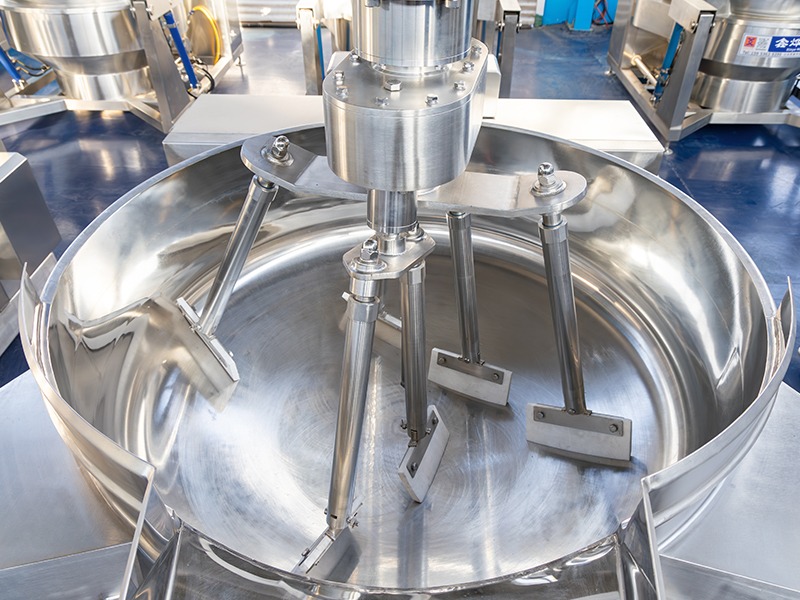
A steam jacketed kettle heats indirectly. Rather than applying flame or an electric element directly to the product, steam is generated by an electric heating system and circulated through a sealed jacket surrounding the cooking vessel. Heat is transferred through the vessel wall itself, which spreads thermal energy evenly across the entire surface rather than concentrating it at one point. This is the core reason an electric steam jacketed kettle is so widely used for viscous or sugar-heavy products: even, gentle heat transfer is what prevents the caramelization, scorching, and burn-on that destroy both product quality and usable yield.
| Jacket Type | Heat Distribution | Best Suited For |
|---|---|---|
| Full (smooth) steam jacket | Very even, large surface contact area | Thick pastes, fillings, sugar-based products prone to caramelization |
| Dimple jacket | Good distribution, slightly higher turbulence in the steam layer | General-purpose sauces, soups, and lower-viscosity products |
Both designs outperform direct-fire or open-element heating in terms of yield protection, since neither creates a hot spot at the base of the pot where product would otherwise stick and burn.
Heat transfer method is only half the story — control precision is the other half. Modern electric steam systems regulate jacket temperature through closed-loop controllers that typically hold the setpoint within roughly ±1–2°C, compared to the wider swings common on manually valved steam systems. That precision matters because most yield-robbing events happen at the margins: a few degrees too hot for a few minutes too long is enough to over-reduce a sauce past its target solids content, or to scorch the bottom layer of a thick paste before the rest of the batch even finishes cooking.
| Process Variable | Impact on Yield if Uncontrolled | How Precision Control Helps |
|---|---|---|
| Jacket temperature | Scorching, burn-on, caramelization loss | Closed-loop control holds setpoint within a narrow band |
| Moisture evaporation rate | Product over-reduces below target weight/solids | Programmable heating curves slow the ramp near the endpoint |
| Batch-to-batch heat timing | Inconsistent output forces over-filling recipes | Recipe memory repeats the same curve every run |
| Discharge residue | Product left adhered to the vessel wall | Smooth SUS304 interior and full-tilt discharge |
Discharge is one of the most underrated yield factors in kettle cooking. A pot that cannot fully empty leaves product behind after every single batch, and over hundreds of batches per month, that residue becomes a measurable loss. This is where the mechanical design of an industrial steam kettle matters as much as its heating system. Kettles built with hydraulic tilting — commonly up to a full 90 degrees — allow dense, sticky products to be discharged completely rather than scraped out by hand, which both protects yield and reduces labor time between batches.
Surface finish plays a similar role. Interiors built from food-grade SUS304 stainless steel resist pitting and micro-scratching that would otherwise trap product and encourage buildup. Beyond the yield benefit, this construction aligns with the sanitary design principles laid out in food equipment standards such as NSF/ANSI 4, which covers commercial cooking and steam-heated equipment including kettles(source). Equipment that is easier to clean thoroughly between runs also reduces the cross-contamination risk that can force an entire batch to be discarded — a far more costly form of yield loss than a few kilograms of residue in the pot.
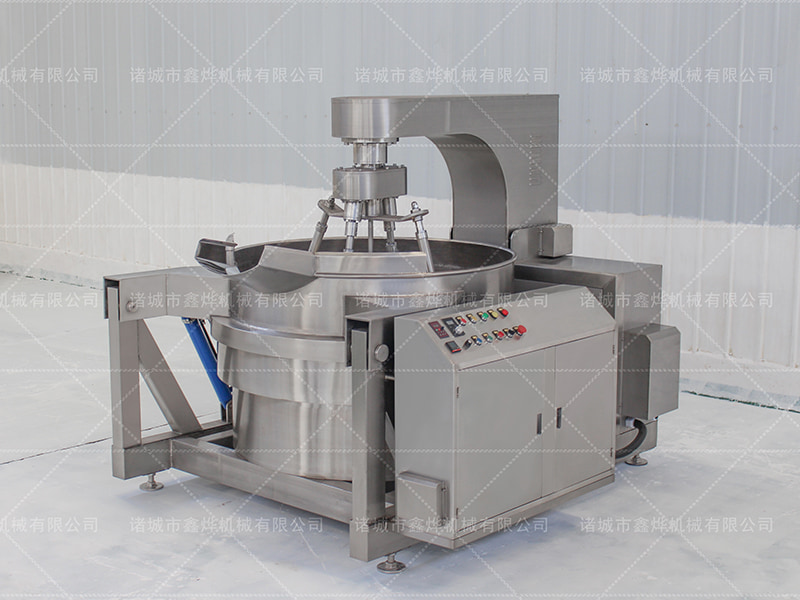
Yield is not just about a single perfect batch — it is about hitting that same result reliably, shift after shift. Manual valve-based steam kettles depend heavily on operator experience, which means output can vary noticeably between shifts or between operators. Programmable controllers on modern electric systems remove much of that variability by storing exact heating curves — ramp rate, hold temperature, hold time — for each recipe, so the kettle repeats the same thermal profile every time it runs.
This consistency also matters for regulatory and quality documentation. Food processing equipment intended for large-scale or export production is often reviewed against recognized sanitary design guidelines, such as the voluntary equipment review programs maintained by the USDA's Agricultural Marketing Service(source). Choosing equipment engineered with this level of documentation and repeatability in mind makes it easier to standardize output across multiple production lines or facilities.
Heat transfer and discharge design solve part of the yield equation, but for thick sauces, pastes, and fillings, agitation is just as important. Without constant, even mixing, the layer of product closest to the jacket wall overheats long before the center of the batch reaches temperature — which is exactly how localized scorching happens even inside a well-designed electric steam jacketed kettle. Multi-head or multi-claw agitators address this by continuously folding product away from the heated wall, which keeps the whole batch cooking at a more uniform rate and protects both texture and total recoverable yield.
When evaluating kettle capacity, it is worth sizing for actual production volume rather than rounding up "to be safe." An oversized kettle running under-filled batches often loses more relative yield to surface-area heat exposure than a correctly sized kettle running full batches — one more example of how equipment selection, not just recipe formulation, drives real-world output.
Protecting yield starts with equipment built for consistent, even heat and complete discharge. XINYE designs and manufactures electric steam jacketed kettles and industrial steam kettles with agitators, engineered around SUS304 sanitary construction, precise steam-jacket temperature control, and full hydraulic tilt discharge for heavy-duty, high-volume food production. If a production line is losing yield to scorching, inconsistent batches, or product left behind after discharge, XINYE's engineering team can help specify the right kettle capacity, jacket type, and agitation setup for the recipe.
Request a Free Quote & Technical ConsultationMaximizing food production yield is rarely about changing the recipe — it is about controlling the variables that quietly erode output during cooking: uneven heat, imprecise temperature control, incomplete discharge, and inconsistent batch timing. An electric steam jacketed kettle addresses the first two by transferring heat evenly through a controlled steam jacket rather than direct flame or elements. A well-designed industrial steam kettle addresses the second two through hydraulic tilt discharge, smooth sanitary interiors, and programmable, repeatable heating curves. Together, these factors turn yield from a variable that depends on operator skill into a predictable, engineered outcome — which is exactly what high-volume food manufacturers need to plan production with confidence.
What makes an electric steam jacketed kettle better for yield than direct-heat cooking?
Direct-flame or direct-element heating concentrates energy at one point, which causes localized scorching and burn-on. A steam jacket spreads heat evenly across the whole vessel wall, so the product heats more uniformly and less material is lost to scorched or overcooked layers.
How much yield can better temperature control actually save?
The exact figure depends on the recipe and current process variability, but even small reductions in over-reduction, scorching, and discharge residue typically add up to a meaningful percentage of output over a full production run, since the losses repeat with every single batch.
Does agitation affect yield, or only mixing quality?
Both. Without continuous agitation, product near the jacket wall overheats before the rest of the batch reaches temperature, which causes localized scorching even in a well-controlled kettle. Agitation protects yield as much as it protects texture and consistency.
Is a fully tilting kettle necessary, or is manual scooping enough?
Manual scooping typically leaves noticeably more product behind than a full hydraulic tilt discharge, especially with thick or sticky products. Over hundreds of batches, that residual product represents real, recoverable yield.
What steam pressure range is typical for industrial kettles?
Most industrial steam jacketed kettles operate in the range of roughly 15–100 psi (1–7 bar) jacket pressure, with the specific setting determined by the recipe, batch size, and desired heating speed.
Can one kettle handle both delicate and heavy-duty products without yield loss?
Generally yes, provided the kettle has programmable temperature and time curves for different recipes and adjustable agitation speed. Storing separate heating profiles per product is the most reliable way to protect yield across a varied production mix.
This article is intended as general technical guidance for food production planning and does not replace equipment-specific engineering review, HACCP documentation, or applicable local food safety regulations.

 Phone:0086-15908033216
 E-mail: olivia.xinye@gmail.com
 Whatsapp/WeChat: +86 15169588915
 ADD: No.78, Jianqiao Road, Shunwang Sub-district, Zhucheng City, Weifang City, Shandong Province
Customer Message
Designed by Zhonghuan InternetCopyRight © 2026 ZHUCHENG XINYE MACHINERY CO., LTD. All rights reserved All tags Sitemap